Mahzor

New York Public Library

Churches

Sarajevo Haggadah

Mah Nishtanah

Sarajevo haggadah

Antaea Darom

Israeli women's art

Action

Torah as music

Ben Heine

Action

ceramic bowl

Mohammad Said Kalash, "Offering Reconciliation" exhibit (photo: Ilan Amihai)

Action

Punch and Judy/Pinchas and Jamila

Avi Katz

Action

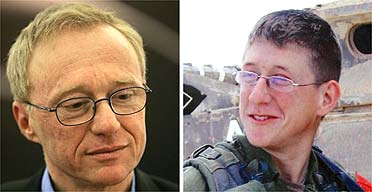
David Grossman

Ben Heine

Action

Eldrige Street shul

Lower East Side

Action

Dove

Ben Heine

Action

Two birds

Hoda Jamal

Action

Israeli and Palestinian boys

from documentary, Promises

Action

Cat in the Hat

Yiddish version

Action

Daylight through the Wall

Banksy: graffiti art on Separation Wall

Action

Maurice Sendak's Brundibar set

New Victory Theater (photo: Nan Melville/NYT)

Action

Daniel Barenboim, West-Eastern Divan Orchestra

Palestinian-Israeli musical ensemble (photo: Kerstin Joensson/AP)

Action

Great Day on Eldrige Street

N.Y.'s klezmer greats celebrate shul rededication (photo: Leo Sorel)

Action

Joint Appeal for Peace

(Avi Katz)

Joint Appeal for Peace

Ketubah, Ancona, Italy (1772)

(Jewish Theological Seminary library)

Ancona ketubah

Archive for the ‘The Arts’ Category

Jeffrey Goldberg’s Head Explodes…Again, Over Caryl Churchill’s Gaza Play

Thursday, February 19th, 2009

Now I’ve got your attention. Well, Goldberg’s head didn’t exactly explode. But he did–shockingly I might add–discover an anti-Semitic blood libel going on right under our noses. And we never even knew!

Yes, the distinguished English playwright Caryl Churchill has written a 10 minute meditation on the meaning of Zionism in the aftermath of the recent Gaza attack, Seven Jewish Children (read script–pdf). The theater piece is provocative, no question. It raises all sorts of questions about how Jews should respond to both their history (i.e. the Holocaust), the modern state of Israel, and its treatment of the Palestinians.

What partisans like Goldberg want you to believe is that it is impermissible to remind Jews that because they were the victims of the Shoah that they should be supremely sensitive to victimizing another people. That is treif by Goldberg. The Shoah is unique. It is the Jews’ beautiful burden to bear before the world. It must never be referenced except in its own right and context. Never compare it to anything else because it was incomparable. No one suffers as we suffered. No one can ever suffer as we suffered. To even whisper that we can cause suffering to others that even begins to come close to rivaling what we suffered is a shande. Shame on you!

Here is the most disturbing final passage, which is what Golberg objects to:

Tell her the Hamas fighters have been killed
Tell her they’re terrorists
Tell her they’re filth
Don’t
Don’t tell her about the family of dead girls
Tell her you can’t believe what you see on television
Tell her we killed the babies by mistake
Don’t tell her anything about the army
Tell her, tell her about the army, tell her to be proud of the army.
Tell her about the family of dead girls, tell her their names why
not, tell her the whole world knows why shouldn’t she know? tell
her there’s dead babies, did she see babies? tell her she’s got
nothing to be ashamed of. Tell her they did it to themselves. Tell
her they want their children killed to make people sorry for them,
tell her I’m not sorry for them, tell her not to be sorry for them,
tell her we’re the ones to be sorry for, tell her they can’t talk
suffering to us. Tell her we’re the iron fist now, tell her it’s the fog
of war, tell her we won’t stop killing them till we’re safe, tell her I
laughed when I saw the dead policemen, tell her they’re animals
living in rubble now, tell her I wouldn’t care if we wiped them out,
the world would hate us is the only thing, tell her I don’t care if
the world hates us, tell her we’re better haters, tell her we’re
chosen people, tell her I look at one of their children covered in
blood and what do I feel? tell her all I feel is happy it’s not her.
Don’t tell her that.
Tell her we love her.
Don’t frighten her.

Is this troubling? Yes. But is this language that was never uttered by Israelis in discussing Gaza? No. Is Churchill making things up out of whole cloth? No. Are these ideas common to many Jews and Israelis? Certainly. In fact, you could read far worse hate published by commenters to this blog (or to be more accurate, comments Israel supporters attempted to publish, as some were so hateful and vicious they never saw the light of day).

I call Seven Children a meditation because to call it a play is misleading. It’s not a linear narrative with defined characters. It’s a series of thoughts, slogans and ideas thrown up against each other. There is dissonance, there is anger, there is heedlessness, there is hatred, there is love. And contrary to Goldberg’s head-exploding claim that this is a blood libel, nothing could be farther from the truth.

Boy and girls, no Jews are being killed at the Royal Court Theater where this piece is currently running. No one is shouting “Death to Jews” when they leave the theater. No one will hate Israel (unless they already do) after seeing this play.

What’s really troubling Jeffrey Goldberg about Seven Children? That people will be forced to think thoughts about Israel, some unpleasant thoughts. That they will ask questions, unpleasant questions. That they will grapple with difficult questions of rights and wrongs. That they won’t have any pat answers and certainly not ones that end up by patting viewers on the back for their easy support for Israel in its current predicament.

That’s the problem with the querulous pro-Israel crowd like Goldberg: there are blood-libelers under every bed and nowhere for Jews to run, nowhere to hide. It’s really a tiresome attitude that infantilizes Jews and Israel. Goldberg’s approach would have the world eating pablum and teething biscuits when it comes to discussing the hard, intractable questions about the Israeli-Arab conflict. In fact, Churchill’s play perfectly encapsulates this attitude in advice it proffers to adults about what they should say about the conflict to the “child:”

Tell her she can’t watch the news
Tell her she can watch cartoons
Tell her she can stay up late and watch Friends.
Tell her they’re attacking with rockets
Don’t frighten her
Tell her only a few of us have been killed
Tell her the army has come to our defence

Goldberg is of the camp that we can’t tell “her” anything. Not only that, but the world can’t tell her anything either. Protect her from the unpleasantness at all costs. And anyone like Churchill who threatens to break through the protective shield is a blood-libeler.

It appears Goldberg’s “blood-libel” slogan was derived from a post at the Trotskyite pro-Israel Harry’s Place blog. Which should teach him something about that blog’s level of histrionics. Both Harry’s Place & Goldberg should remember the story about the boy who cried wolf once too often. After a while, everyone turned their backs and said: “There he goes again.” And that was the time he needed to be believed most.

The Times story reveals that James Nicola’s New York Theater Workshop is contemplating bringing this piece to New York. He is the very same who buckled under imaginary pressure and refused to produce Rachel Corrie when it was offered to him. Though Corrie wasn’t a very good play, that wasn’t the reason he refused it. He refused it because he was afraid is was too provocative and would be too offensive to New York’s Jewish population.

The problem Nicola has here is that Churchill’s piece is not a bad play. It is a very good and provocative play. And because it is a play that carefully represents many conflicting emotions and points of view (as opposed to agit prop), it is even more challenging than Rachel Corrie was. If he couldn’t deal with Corrie how will he deal with this?

‘With An Iron Pen’: Collection of Israeli Anti-Occupation Poetry

Wednesday, February 18th, 2009


Clare Kinberg, editor of Bridges: A Jewish Feminist Journal, brings welcome news of the publication of a new translation of political poetry from Hebrew, With An Iron Pen, dealing with the matzav in a critical context. Here’s what SUNY Press has to say about the book:

A groundbreaking collection of forty-two Israeli poetic voices protesting the occupation of the West Bank.

The eighty-eight poems in With an Iron Pen, all originally written in Hebrew, offer a collective protest to the continuing Israeli occupation of the West Bank and Palestinian territories—“the sin of Judah,” which is written “with an iron pen, engraved with the point of a diamond on the tablet of their hearts” (Jeremiah 17:1).

Including such preeminent voices as Yehuda Amichai, Aharon Shabtai, Dahlia Ravikovitch, Meir Wieseltier, and Natan Zach, the forty-two poets in this groundbreaking anthology represent the full range of contemporary Hebrew poetry. Together, they turn an unforgiving gaze on the Occupation, speaking with rage, shame, sorrow, and despair at the continuing violence that has defined the lives of Palestinians and Israelis over the years, and the hopelessness that has permeated both societies. The result is a collection of poems that are as important for their compelling poetic beauty as for their significant political accomplishment. The original Hebrew edition, published in 2005, received accolades in the Israeli press for its comprehensive collection of dissenting voices and for its daring and beautiful poetry. With an Iron Pen is a must read for all who seek a better understanding of the occupation and the wider conflict in the Middle East.

“These dissident Israeli voices, recognized and new, prophetic, raging, heartbroken, challenging, public and intimate, from the moral core of Jewish tradition, have gone almost unheard in America until now. The lyrical range is impressive, the edition scholarly; this is a historic collection.” — Adrienne Rich

Tal Nitzan has published three poetry collections, including Domestica and An Ordinary Evening. A preeminent translator of Spanish into Hebrew, she has translated over forty books and won numerous awards for her work. Rachel Tzvia Back has translated works for numerous anthologies, including The Defiant Muse: Hebrew Feminist Poems from Antiquity to the Present; Lea Goldberg: Selected Poetry and Drama; and With this Night. Her own poetry collections are Azimuth, The Buffalo Poems, and On Ruins & Return. She is Professor of Literature at Oranim College and Bar-Ilan University.

The book should be an Israeli echo of the fierce poetry of Mahmoud Darwish which reflects these issues from a Palestinian perspective.

Regarding the quotation from Jeremiah from which the title of the collection is taken, it strongly reminds me of the Kafka story, In the Penal Colony. There too the sins of prisoners are etched in their flesh by a monstrous type of pen or, as it’s called in the story, a “harrow”:

[The] apparatus stands here in front of us. As you see, it consists of three parts…The one underneath is called the Bed, the upper one is called the Inscriber, and here in the middle, this moving part is called the Harrow.” “The Harrow?” the Traveller asked…

“Yes, the Harrow,” said the Officer. “The name fits. The needles are arranged as in a harrow, and the whole thing is driven like a harrow, although it stays in one place and is, in principle, much more artistic. You’ll understand in a moment. The condemned is laid out here on the Bed. ..

As soon as the man is strapped in securely, the Bed is set in motion…But it’s the Harrow which has the job of actually carrying out the sentence.”

…“Our sentence does not sound severe. The law which a condemned man has violated is inscribed on his body with the Harrow. This Condemned Man, for example,” and the Officer pointed to the man, “will have inscribed on his body, ‘Honour your superiors.’”

I never cease to be amazed at both the evocativeness of Biblical allusions in modern literature, but at the depth of specifically Jewish allusions in Kafka’s work. Certainly it would be interesting to know whether Kafka had read this passage from Jeremiah and whether he deliberately invoked it. But in a way it doesn’t matter for Kafka’s work embodies so fully the prophetic outlook and its preoccupations with justice, sin and redemption, that he needn’t necessarily have been fully aware of this passage in order to echo it in the story.

The Israeli Occupation too is like the harrow of Kafka’s story in that it etches both the sin and punishment directly onto the bodies of Israelis and Palestinians alike. It draws the blood of the victim in the same way, at times in great volumes and at times in tiny pinpricks. And as in the Kafka story, where the sentence takes an interminable 12 hours to execute, the Occupation has gone on now for forty years with still no end in sight.

Palestinian Artist Wins Guggenheim/Hugo Boss Award

Sunday, November 16th, 2008
Emily Jacir, Hugo Boss/Guggenheim winner

Emily Jacir, Hugo Boss/Guggenheim winner (Sarah Shatz)

The Guggenheim Museum announced that Palestinian artist, Emily Jacir has won this year’s prestigious Hugo Boss Award:

Emily Jacir, the 37-year-old artist of Palestinian descent…has won this year’s Hugo Boss Prize.

The $100,000 award, established in 1996 by the Guggenheim Museum and named for the German men’s wear company that sponsors it, is given every two years for significant achievement in contemporary art…

Ms. Jacir, who divides her time between Ramallah…and New York, won the Golden Lion Award…at the 2007 Venice Biennale. Her work there, a room-size installation in the Italian pavilion, documented the assassination of the Palestinian intellectual Wael Zwaiter by Israeli agents in Rome in 1972 for what they believed was his role in the massacre of Israeli athletes at that year’s Summer Olympics.** Using photographs, objects, texts and interviews, she created a narrative that reflects on her own anguish over the Middle East.

The Hugo Boss Award jurors had this to say about her work:

“Emily Jacir’s rigorous conceptual practice—comprising photography, video, performance, and installation-based work—bears witness to a culture torn by war and displacement. As a member of the Palestinian diaspora, she comments on issues of mobility (or the lack thereof), border crises, and historical amnesia through projects that unearth individual narratives and collective experiences. Jacir combines the roles of archivist, activist, and poet to create poignant and memorable works of art that are at once intensely personal and deeply political. It is the refined sophistication of Jacir’s art and the relevance of her concerns—both global and local—in a time of war, transnationalism, and mass migration that led us to award her the 2008 Hugo Boss Prize.”

This is a description of another work of hers which sounds interesting and provocative:

Where We Come From…was recently acquired by the San Francisco Museum of Modern Art. Jacir asked Palestinians around the world: “If I could do something for you, anywhere in Palestine, what would it be?” She then documented herself fulfilling the requests for people who are prohibited entry into their homeland and/or restricted from movement within it. She visited a mother’s grave, played soccer with a boy in Haifa, and visited a student’s family in Gaza because he is prevented from traveling home while at school in the West Bank.

And another fascinating project:

Crossing Surda (A Record Of Going To And From Work), which was inspired by Israeli soldiers throwing her passport in the mud and holding a gun to her temple at a checkpoint between Ramallah and Birzeit University, and involved her cutting a hole in the bottom of her handbag and stealthily filming her trek across the same terrain, to and from teaching classes, as a generative gesture of revenge…

I’ve featured this story for two reasons: one, that I wish to highlight anyone, whether Jewish or Muslim; Israeli Jew or Palestinian who achieves distinction working for peace and justice for either or both peoples; two, Palestinians, including their artists, generally labor in obscurity.  For those of us who read the N.Y. Times daily (you can fill in the name of your own daily paper), why hasn’t Ethan Bronner done a feature story about Jacir, whose work has earned numerous international art awards?  Why when we think of the word “Palestinian,” do we not even think of the word “artist?”  And isn’t this another symptom of the cultural impoverishment foisted upon us by this age-old conflict?

If you live in or near New York, the Guggenheim will host a show of Jacir’s work from February 6-April 15th.  The National has featured a fine profile of Jacir.

**Actually, the Mossad’s “Wrath of God” operation was supposedly intended to gun down the Palestinians who planned and executed the Munich Olympic massacre.  But many of the assassinated victims were Palestinian artists and intellectuals who had nothing to do with Munich.  While the Mossad claims Zwaiter was involved, Palestinians who knew him claimed he was “energetically against terrorism.”

Bibi’s Barack Rip-Off

Friday, November 14th, 2008
Bibi's Barack ripoff

Bibi Barack ripoff

Barack Obama established that he has political coattails that helped Democrats get elected to Congress this year.  But do his coattails extend as far as Israel?  And will they help a right-wing Israeli nationalist war horse get elected?  That’s what Bibi Netanyahu’s banking on.

Change We Can…Rip Off

The N.Y. Times brings word of one of the great digital rip-offs of recent political history.  If you visit Bibi’s website you’ll find his web designer has almost entirely ripped off Barack Obama’s website down to color scheme, text placement, and even slogans.

Everyone loves a winner, but this is ridiculous.  Bibi and Barack share absolutely nothing in common.  Of all the Israeli candidates for prime minister in the upcoming election, Bibi is the one Obama has to want least to succeed.  Bibi is the old war horse.  Barack is the new, new thing.  Bibi is the Ashkenazi grandee.  Barack is half-breed rabble rouser.

You’ve gotta hand it to Bibi.  He has no new ideas either political or digital, so he steals from his betters.  He has no creativity.  That’s why the most right-wing of Israel’s candidates can claim with a straight face that he too is the candidate of change.

He imports his website and themes from abroad and attempts to graft them onto an Israeli political reality.  But just like in the natural landscape Bibi is the invasive species and not the native plant.  He wants bragging rights assuming the Israeli voter will be jazzed that he’s modeling his campaign after a trendy young U.S. politician.  Somehow this will find resonance for the Israeli voter.  Notice that Bibi’s site has Twitter when there are only a few thousand in the entire country who use it.  And given what we know about Twitter users here, how many Israeli Twitter users are going to be Bibi fans?

At this rate, he might as well steal Obama’s entire campaign lock, stock and barrel.  He could put on blackface, start working out, lose a few pounds, claim he’s a half-Mizrahi, and call for negotiations with Hamas.  Now that WOULD be a change.  And the voters would be so shocked they’d vote for him in droves.

Until then, Bibi habibi, get real.  No Israeli will believe that this leopard could change its spots.  He’s the same old wine in old bottles.  Nothing’s changed.  The same failed policies you saw when he was last prime minister are what Israelis will get if they give him another chance.

Bibi website features Obama prominently.  How do you spell s-h-a-m-e-l-e-s-s?

Bibi website features Obama prominently. How do you spell shameless? B-I-B-I

You’ve got to credit Bibi’s scumbag advisors with trying to make lemonade out of the lemon of a candidate that they have.  This gives the word chutzpah new dimensions.  Please remove any food or drink from your mouth as you may accidentally spew as you read this:

…Dore Gold…a close Netanyahu adviser, said the Likud leader liked and respected Mr. Obama, so it was not strange that he had taken a page from the president-elect. Mr. Gold said the two meetings they had held so far, in Washington in 2007 and in Jerusalem last summer, had gone well.

“I was at both meetings, and it was clear that the two leaders established a very good chemistry very quickly,” he said. “We are convinced that the Obama administration will be open to hearing new ideas from Israel on how to make progress in the region.”

Mr. Netanyahu is positioning himself as the candidate of new ideas both for Israel itself and for peace with the Palestinians.

Just what are those bold, innovative ideas for peace with the Palestinians?

The ideas revolve around economic opportunities, aides say, cutting red tape to improve the Palestinian economy; building peace from the ground up, not the top down…

The aides are convinced that negotiations with Palestinian leaders will lead nowhere and the best steps Israel can take, as it waits for Palestinian attitudes to change, involve building the Palestinian economy.

What a cruel hoax this man is playing.  The Palestinians will never be fooled by this narischkeit.  I hope Israeli voters aren’t either.

Jonah’s ‘Image of Small City’

Tuesday, November 11th, 2008

Artist: Jonah Title: Small part of a city

Artist: Jonah
Title: Small part of a city

Jonah’s ‘Biggest City in the World

Tuesday, November 11th, 2008

Artist: Jonah Title: Biggest City in the World

Artist: Jonah
Title: Biggest City in the World

Jonah’s ‘Elephant in the Jungle’

Tuesday, November 11th, 2008

Artist: Jonah Title: Elephant in the jungle

Artist: Jonah
Title: Elephant in the jungle

Jonah’s Towncity

Tuesday, November 11th, 2008

Artist: Jonah Title: Towncity

Artist: Jonah
Title: Towncity

Performance Optimization WordPress Plugins by W3 EDGE