Mahzor

New York Public Library

Churches

Sarajevo Haggadah

Mah Nishtanah

Sarajevo haggadah

Antaea Darom

Israeli women's art

Action

Torah as music

Ben Heine

Action

ceramic bowl

Mohammad Said Kalash, "Offering Reconciliation" exhibit (photo: Ilan Amihai)

Action

Punch and Judy/Pinchas and Jamila

Avi Katz

Action

David Grossman

Ben Heine

Action

Eldrige Street shul

Lower East Side

Action

Dove

Ben Heine

Action

Two birds

Hoda Jamal

Action

Israeli and Palestinian boys

from documentary, Promises

Action

Cat in the Hat

Yiddish version

Action

Daylight through the Wall

Banksy: graffiti art on Separation Wall

Action

Maurice Sendak's Brundibar set

New Victory Theater (photo: Nan Melville/NYT)

Action

Daniel Barenboim, West-Eastern Divan Orchestra

Palestinian-Israeli musical ensemble (photo: Kerstin Joensson/AP)

Action

Great Day on Eldrige Street

N.Y.'s klezmer greats celebrate shul rededication (photo: Leo Sorel)

Action

Joint Appeal for Peace

(Avi Katz)

Joint Appeal for Peace

Ketubah, Ancona, Italy (1772)

(Jewish Theological Seminary library)

Ancona ketubah

Archive for December, 2003

Wiggles, How Do I Hate Thee? Let Me Count the Ways

Wednesday, December 31st, 2003

The Wiggles are Dead! Now let’s start the celebration!

Brian at Being Daddy has produced Wiggles Wiggle Out Of Wiggles, a delicious piece of satire that announces the demise of the execrable singing group. I swear I thought it was the Real McCoy. My heart leapt for joy! But when I followed his link to the real Wiggles website, which announced future concert dates, I realized that Brian was ‘having us on.’ Good on ‘ya, Brian, as the Irish would say. He had me going there.

Here’s some of what I wrote at Brian’s blog BEFORE I realized he had spoofed us all:

“I’m sorry to be such a spoilsport but I detest the Wiggles. Call me a snob, call me an overeducated, fun-hating adult…I just don’t care. I thought they were an insult to just about everything they tried to do or be: children’s entertainment, music, storytelling, you name it.

We were given a single CD by someone who thought they were doing us a favor. UGH! My son, of course, loved the video. It got to the point where I thought if I have to watch it again I’ll shoot myself. So I threw it behind the books in the bookcase & I’ve never heard a request for it since.

Wiggles–how do I hate thee? Let me count the ways:

1. lip synching
2. fake guitar playing
3. insipid, unimaginative stories, acting and songs

Need I say more? The Wiggles’ breakup makes me so happy I’m gonna go blog about it back at my blog.

Lest you think I’m a total misanthrope–there are lots of children’s cds and videos I (& my son) adore: HBO’s Goodnight, Moon, Dumbo, Peter Pan, Fantasia, Rikki Tikki Tavi, etc. There IS intelligent, thoughtful, entertaining children’s videos out there. YOu just have to do some careful research and careful buying.

At my blog, I’ve posted my entertainment recommendations at Children’s Video: The Good, the Bad and the Ugly

Seattle Snow

Wednesday, December 31st, 2003

Bellevue & Cascades in late winter snowIt snows here in Seattle some winters. And this is one of them. I can’t remember any appreciable snow falling for 3 years or so. This wasn’t a big snowfall. But it was enough for my 2 1/2 year old to be able to build his first snowman with his young friend, Simon.Winter sky

Of course, lots of snow falls in the Cascades which are only a 40 minute drive or so from the heart of the city. So we have winter sports galore. But the city, except for some years which are major exceptions to the rule, usually gets a few inches a winter and that melts the next day. There have been a few years in which snow stayed on the ground for days and the entire city was paralyzed. But that, as I said, is the exception.

I’ve displayed here a few photographs of past Seattle snowfalls and winter views of the Cascades.

’21 Grams’: Lost Souls in a Grim, Unforgiving World

Tuesday, December 30th, 2003
21 Grams movie logo

21 Grams movie logo

My wife and I recently saw 21 Grams and were extremely disappointed. I’d been enticed by Elvis Mitchell’s glowing review, Hearts Incapacitated, Souls Wasting Away in the New York Times:

It’s too early to call it a crowning work of a career — this is only his second film — but it may well be the crowning work of this year.

I think not. The film’s premise might have made a deeply powerful piece of art. Casting too, promised many wonderful performances from the likes of Sean Penn, Naomi Watts and Benicio Del Toro.

Naomi Watts

Naomi Watts

In the film, a woman’s family is wiped out by a hit and run driver. Her dead husband’s heart is given to a dying heart patient who is drawn to her because of her tie to the heart donor. But the execution of the concept in this film is not successful for me.

Let’s talk about tone: this film is GRIM, GRIM, GRIM. I have nothing against ‘grim’ in films. Some of the greatest films are fundamentally grim. But this one is unrelentingly grim. There isn’t a single character major or minor for whom I felt any sympathy.

Benicio Del Toro

Benicio Del Toro

Let’s take a single scene featuring Benicio del Toro’s ravaged ex-con turned angry Christian. Sitting at the dinner table, del Toro’s son smacks his sister. When she tries to hit her brother back, del Toro tells her menacingly that she must learn to turn the other cheek when someone hits her. He jumps across the table and holds his daughter’s face and screams at his son to hit her. When the petrified boy refuses, del Toro bellows at him to hit her. He finally does. But then both daughter and son collapse in tears and his wife leaves the table, disgusted to console them. Nice fellow, don’t you think?

Now, let’s talk about implausible plot developments. Just after the funeral, the widow declares that she doesn’t even have a desire to press charges against the hit and run driver saying: “What would it prove?” Yet after meeting and falling in love with Sean Penn’s character, she suddenly develops a burning, unquenchable thirst for revenge: “We’ve got to kill him,” she says. A little discongruity you say? Sure is.

Sean Penn in 21 Grams

Sean Penn in 21 Grams

And in the climactic scene in which Sean Penn, del Toro and Naomi Watt each struggle with a loaded gun, Penn’s character decides to end the fight by shooting himself in the heart. If I killed myself in the middle of every argument I’ve ever wanted to stop, I’d have at least nine lives if not more.

Finally (and this to me was one of the more annoying features of the film), the editing. It appears the film editor and director wanted to jumble up the scenes so that you couldn’t tell when the action took place. Is this Sean Penn scene after the heart transplant or before? Is this Naomi Watt scene before her family’s death or after? Unlike Memento, in which the action is shown in reverse chronological order, the jumbled chronology in 21 Grams seems willful and perverse, as if it were thrown into the film to throw the viewer’s ‘center of balance’ off.

We left the theater feeling very unsatisfied.

Shibley Telhami: A Moderate Palestinian-American’s Vision for Mideast Peace

Tuesday, December 30th, 2003

This is another in a series focussing on moderate Arab intellectuals who advocate a tolerant vision of Islam and peace between Israelis and Palestinians. Previous segments in this series have highlighted the work of Sari Nusseibeh, Irshad Manji, Tariq Ramadan, Khaled Abou El Fadl.

Shibley Telhami

Shibley Telhami

Shibley Telhami is the Anwar Sadat Professor for Peace and Development at the University of Maryland, College Park, and senior fellow at the Saban Center at the Brookings Institution. He is a member of the Council on Foreign Relations and serves on the boards of Human Rights Watch (and as vice-chair of Human Rights Watch/Middle East), Seeds of Peace, the Education for Employment Foundation, and Neve Shalom/Wahat al-Salam, and several academic advisory boards. He completed his PhD in political science at UC Berkeley.

For a more in depth perspective on Telhami’s views of the Israeli-Palestinian conflict, read U.S. Foreign Policy and the Search for Peace in the Middle East a UC Berkeley Institute for International Studies interview between Harry Kreisler & Telhami. Here Telhami talks about his early life in an Israeli Arab village:

I was born in a little village, an Arab village near the city of Haifa. It’s on the highest peak of Mount Carmel, overlooking the Mediterranean in a wonderful setting. Although it’s only about fifteen minutes from the city of Haifa, when I grew up in the fifties — I was born in 1951 — in those years, the village was highly underdeveloped. The road to Haifa made Haifa seem like a continent away. The village didn’t have running water, did not have electricity. It was very much a village, and it was rare that I, as a child, would go to Haifa. Transportation existed but not on a regular basis, and typically, children did not make it into the city very often.

He was born Christian within a majority Druse village:

The majority of the people in the village were Druse. Druse are a derivative of Islam, but they have their own independent religion. In the village, there was also a Christian minority and also an Arab Christian minority, of which my family was a member, and there was also a very small Muslim community as well.

Growing up, he did not feel the sting of discrimination that many other Israeli Arabs felt because his village was quite remote, located at the highest point of Mt. Carmel just outside Haifa. Telhami’s father and grandfather were leaders of the village and they never made distinctions between Christian, Druse, Muslim or Jew. They had many close friendships with Israelis which continue to this day. This may explain why Telhami’s analysis of the conflict lacks much of the hard edge and rhetorical anger of other Palestinian and Israeli Arab intellectuals (Edward Said being but one example).

Telhami is a strong believer in the necessity for active U.S. engagement in Israeli-Palestinian negotiations for peace:

As we reflect on the future of American policy in the region after the Iraq war, one thing remains the same: any strategy to reduce militancy, anti-Americanism and repression in the Middle East cannot succeed unless a robust effort to mediate a fair Arab-Israeli peace is a priority.

He, along with many other Mideast specialists faults the Bush Adminstration for not taking advantage of the leverage it has to push both sides toward more realistic and moderate positions.

His more recent research involves a survey of political, social and religious attitudes in the Arab world. He discovered that the single most important issue for Arabs is the Israel-Palestine conflict. Until we can resolve this complex problem, we cannot hope for ‘normalized’ relations with any of these nations. In addition, Telhami likens this Arab ‘fixation’ with Palestine to world Jewry’s relationship with Israel. Here is how he characaterized it:

Every single survey shows that the central issue in the perception, the central issue that exacerbates everything else is the Arab-Israel issue. Every single survey shows that. Over 60 percent of the Arab public thinks that this is “the single most important issue” to them personally.

Now that doesn’t mean that they’re necessarily willing to go to war over it. It doesn’t mean that they love Yasser Arafat. It may not even mean that they support the PLO. What it does mean is that this issue, particularly the issue of Palestine, has become an issue of national identity, collective identity, in the region for Arabs and Muslims. I would argue in the same way that the issue of Israel has become an issue of identity for contemporary Jewry. You can hate Ariel Sharon, you can dislike the policies of the government of Israel, but if Israelis are seen to be killed, innocent Israelis blown to pieces, or Israel is threatened, you can’t help but be mobilized. This becomes an important issue to you. It reflects on your own identity.

The role of Palestine in the Arab world exists for a lot of reasons. I don’t want to say the Muslim world, because it varies, but in the Arab world. You have to put it in perspective. Arabs fought many devastating wars over this issue. They lost a huge war in 1948. They fought a war in 1956 that they saw as an imperialist war that linked Israel to the West. The 1967 war was devastating; there were more territories lost and thousands of people killed and injured and the economy was destroyed.

Two generations have had their political identity shaped over big events related to this issue, whether it’s war or peace. And it remains an open wound today after half a century, with continued suffering and occupation, and now driven home by the news media so that no one can ignore it. It’s there at the breakfast table, at the dinner table. It exacerbates this wound on the collective psyche of the region.

There is no single issue that affects the psychology of the region and its view of the U.S. more than this. If this issue is resolved, the tension between America and the rest of the Middle East will not be removed—don’t kid yourself—in the same way that there is resentment in Latin America, Asia and Europe, where there is no Arab-Israeli issue. But the intensity of the resentment that plays into the hands of terrorism would be significantly reduced.

‘Be Good, Smile Pretty’: PBS Vietnam documentary

Monday, December 29th, 2003

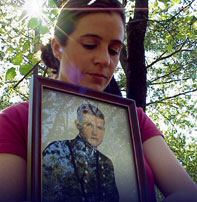
Tracy Droz holding her father's Naval Academy photographAbout a month ago, I saw a deeply moving documentary, Be Good, Smile Pretty, about the death of U.S. Navy officer, Dan Droz, killed in April, 1969 during the Vietnam War. Tracy Tragos, Droz’ daughter and three months old at his death, has made a complex, harrowing and unblinking film about her search for the father she barely knew (the only time she met him was during a Hawaiian R&R visit two weeks before his death) and her struggle to comprehend her mother’s apparent denial or indifferent response to his death.

Tracy’s mother, despite being highly-educated, politically progressive and right-thinking still has the deepest difficulty confronting the memories of his death that her daughter dredges up during the course of filming the documentary. She resents her daughter for unearthing once again the anger and pain she felt as a widow thirty-two years earlier.Judy Droz holding daughter, Tracy at an anti-war rally

It is also important to note that in A Soldier’s Story, John Kerry, one of Droz’ close friends during the War, reveals that he decided he’d finally had enough of combat when he learned of Droz’ death on the River. Within a short time Kerry requested a transfer out of combat with Droz’ death being the catalyst that transformed him into an antiwar activist.

Tracy’s search began in March, 2001 as she typed her father’s name into a Yahoo! search field. Her search uncovered Peter Upton’s The Death of the 43, one of the few written recollections of the ambush which led to Droz’s death along with five of his fellow crewmen. Orphans of War, the producers of the film also maintain additional information about Be Good, Smile Pretty at their site. The Orphans of War Foundation‘s mission is:

to increase awareness of the impact the death of American GIs during the Vietnam War had on their 20,000 surviving sons and daughters. It also wishes to support innovative programs allowing those harmed by the Vietnam War to express their loss and grief.

In the course of the film, Tracy must confront many sources for her anger at his death: her father himself for dying before she could ever know him; her mother who resents the turmoil her search has introduced into their relationship; and finally, the War itself which took away a beautiful, vigorous, intelligent and fun-loving young man in the prime of life. As Tracy meets the men who shared her father’s life while serving with him in Vietnam and hears the stories of her father’s life in the service, her profound longing reveals itself as a deep wound and a palpable, insatiable yearning.

The meeting between Tracy, her mother and Peter Upton, who wrote the definitive memoir of the ambush is espeically laden with pathos. You watch as Upton breaks down with unbearable grief which expresses itself through choking emotion, but few words or tears. And as Upton shudders with grief, both women break down with unbearable grief at the horrible tragedy of Droz’s death and the barren gap it has left in their lives. Few books or films capture the absolute human wastefulness of war as well as Be Good, Smile Pretty.Dan Droz holding his newborn daughter shortly before his own death
PBS’ promotional material describes the film thus:Thirty-two years later, one daughter’s struggle to know and grieve for her father, who died in Vietnam when she was 3 months old, becomes a journey of discovery, healing and remembrance.This ad copy is an example of putting a simple and positive gloss on a work of art that is much more ambivalent, angry and ultimately inconclusive about the moral and family issues it confronts. That is what makes it so powerful and such a great work of art.

In the current political climate, when we face an equally destructive and disruptive war in Iraq, it is timely to consider the lives of our soldiers there that are being wasted and the years of anguish and agony faced by their orphaned children like Tracy Droz Tragos.

Lt. Gen. Anthony Zinni on Bush’s Iraq Policy: “‘These Guys Don’t Have a Clue”

Sunday, December 28th, 2003

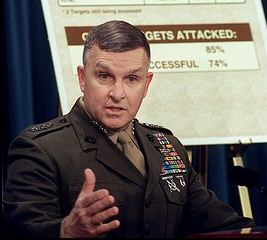
Anthony ZinniOne thing you’ve got to say for Anthony Zinni–the guy’s got guts. The Washington Post’s For Vietnam Vet Anthony Zinni, Another War on Shaky Territory describes where this fearlessness comes from:

He was lying on a Vietnamese mountainside west of Da Nang, three rounds from an AK-47 assault rifle in his side and back. He could feel his lifeblood seeping into the ground as he slipped in and out of consciousness.

He had plenty of time to think in the following months while recuperating in a military hospital in Hawaii. He promised himself, “If I’m ever in a position to say what I think is right, I will. . . . I don’t care what happens to my career.”

Zinni is now speaking his mind about Iraq and has become one of the fiercest military critics of Bush’s War. His opposition is all the more striking because he endorsed Bush-Cheney in 2000 and counts himself as a centrist Republican. He said of Bush:

“I think he ran on a moderate ticket, and that’s my leaning — I’m kind of a Lugar-Hagel-Powell guy,” he says, listing three Republicans associated with centrist foreign policy positions.

It is instructive to hear what this blood and guts, old school officer has to say about our current policy, since he recently served as Bush’s Mideast envoy, served as Centcom commander in the late 1990s and devised his own plan for the U.S. military to occupy Iraq. Here are some salient passages from the article:

“Iraq is in serious danger of coming apart because of lack of planning, underestimating the task and buying into a flawed strategy,” he says. “The longer we stubbornly resist admitting the mistakes and not altering our approach, the harder it will be to pull this chestnut out of the fire.”

I strongly believe that this Zinni statement from 1998 will prove prescient as Iraq moves closer to self-rule and possible chaos:

I think a weakened, fragmented, chaotic Iraq, which could happen if this isn’t done carefully, is more dangerous in the long run than a contained Saddam is now. I don’t think these questions have been thought through or answered.

Zinni also doubts that Sadaam’s capture marks a turning point in our efforts to pacify the Iraqi resistance:

“Since we’ve failed thus far to capitalize” on opportunities in Iraq, he says, “I don’t have confidence we will do it now. I believe the only way it will work now is for the Iraqis themselves to somehow take charge and turn things around. Our policy, strategy, tactics, et cetera, are still screwed up.”

Zinni’s sharp dissent from current U.S. policy began at a 2002 Veterans of Foreign Wars convention at which he was receiving a leadership award for his 35 years of service in the Marine Corps. Sitting on the convention dais, he heard Vice President Cheney baldly contend:

Simply stated, there is no doubt that Saddam Hussein now has weapons of mass destruction,” Cheney said. “There is no doubt that he is amassing them to use against our friends, against our allies, and against us.”

Zinni immediately knew that what Cheney was saying was knowingly false:

Cheney’s certitude bewildered Zinni. As chief of the Central Command, Zinni had been immersed in U.S. intelligence about Iraq. He was all too familiar with the intelligence analysts’ doubts about Iraq’s programs to acquire weapons of mass destruction, or WMD. “In my time at Centcom, I watched the intelligence, and never — not once — did it say, ‘He has WMD.’ ”

Though retired for nearly two years, Zinni says, he remained current on the intelligence through his consulting with the CIA and the military. “I did consulting work for the agency, right up to the beginning of the war. I never saw anything. I’d say to analysts, ‘Where’s the threat?’ ” Their response, he recalls, was, “Silence.”

Zinni’s conclusion as he slowly walked off the stage that day was that the Bush administration was determined to go to war. A moment later, he had another, equally chilling thought: “These guys don’t understand what they are getting into.”

As Centcom chief, Zinni devised his own plan in 1999 for the U.S. to occupy Iraq in case Sadaam ever were to fall. But in the conditions leading up the Iraq War:

He didn’t see any need to invade Iraq. He didn’t think Hussein was much of a worry anymore. “He was contained,” he says. “It was a pain in the ass, but he was contained. He had a deteriorated military. He wasn’t a threat to the region.”

Zinni’s concern deepened at a Senate hearing in February, just six weeks before the war began. As he awaited his turn to testify, he listened to Pentagon and State Department officials talk vaguely about the “uncertainties” of a postwar Iraq. He began to think they were doing the wrong thing the wrong way. “I was listening to the panel, and I realized, ‘These guys don’t have a clue.’ ”

During his service as Centcom commander, he directed the retaliatory air strikes derided by neoconservatives at the time as toothless and ineffective. After hearing from western diplomats based in Baghdad that the strikes had paralyzed the Iraqi dictatorship, he felt he should devise a plan just in case American military power caused the overthrow of Sadaam.

So early in 1999 he ordered that plans be devised for the possibility of the U.S. military having to occupy Iraq. Under the code name “Desert Crossing,” the resulting document called for a nationwide civilian occupation authority, with offices in each of Iraq’s 18 provinces. That plan contrasts sharply, he notes, with the reality of the Coalition Provisional Authority, the U.S. occupation power, which for months this year had almost no presence outside Baghdad — an absence that some Army generals say has increased their burden in Iraq.

Later, when he testified to the Senate Armed Services Committee just before the War began:

Listening to the administration officials testify that day, Zinni began to suspect that his careful plans had been disregarded. Concerned, he later called a general at Central Command’s headquarters in Tampa and asked, “Are you guys looking at Desert Crossing?” The answer, he recalls, was, “What’s that?”

The more he listened to Wolfowitz and other administration officials talk about Iraq, the more Zinni became convinced that interventionist “neoconservative” ideologues were plunging the nation into a war in a part of the world they didn’t understand. “The more I saw, the more I thought that this was the product of the neocons who didn’t understand the region and were going to create havoc there. These were dilettantes from Washington think tanks who never had an idea that worked on the ground.”

Supporters of the war airily dismiss all analogies between Iraq and Vietnam. But Zinni is a soldier who’s lived through both experiences and if anyone’s earned a right to make analogies he has:

Obviously there are differences” between Vietnam and Iraq, he says. “Every situation is unique.” But in his bones, he feels the same chill. “It feels the same. I hear the same things — about [administration charges about] not telling the good news, about cooking up a rationale for getting into the war.” He sees both conflicts as beginning with deception by the U.S. government, drawing a parallel between how the Johnson administration handled the beginning of the Vietnam War and how the Bush administration touted the threat presented by Iraqi weapons of mass destruction. “I think the American people were conned into this,” he says. Referring to the 1964 Gulf of Tonkin incident, in which the Johnson administration claimed that U.S. Navy ships had been subjected to an unprovoked attack by North Vietnam, he says, “The Gulf of Tonkin and the case for WMD and terrorism is synonymous in my mind.”

While I appreciate Zinni’s attack on Wolfowitz and the neoconservatives who devised the strategy (such as it is) for this failed war, I take issue with his views that they somehow “captured” Bush and Cheney. To me, it is crystal clear that Bush and especially Cheney did not need to be captured. They embraced the Wolfowitz-Rumsfeld line:

And that brings him back to Wolfowitz and his neoconservative allies as the root of the problem. “I don’t know where the neocons came from — that wasn’t the platform they ran on,” he says. “Somehow, the neocons captured the president. They captured the vice president.”

He is especially irked that, as he sees it, no senior officials have taken responsibility for their incorrect assessment of the threat posed by Iraq. “What I don’t understand is that the bill of goods the neocons sold him has been proven false, yet heads haven’t rolled,” he says. “Where is the accountability? I think some fairly senior people at the Pentagon ought to go.” Who? “That’s up to the president.”

We can name names here. Zinni is obliquely (but quite openly) saying that Rumsfeld and the other neoconservative wonks at the Pentagon have got to go. As we Jews say in a different context: “May it happen speedily and in our day.” The article continues by noting Zinni’s reticence in becoming a symbol of the anti-war movement. It also notes that such reticence makes those occasions on which he does speak out all the more compelling and gripping:

Zinni has picked his shots carefully — a speech here, a “Nightline” segment or interview there. “My contemporaries, our feelings and sensitivities were forged on the battlefields of Vietnam, where we heard the garbage and the lies, and we saw the sacrifice,” he said at a talk to hundreds of Marine and Navy officers and others at a Crystal City hotel ballroom in September. “I ask you, is it happening again?” The speech, part of a forum sponsored by the U.S. Naval Institute and the Marine Corps Association, received prolonged applause, with many officers standing.

Zinni says that he hasn’t received a single negative response from military people about the stance he has taken. “I was surprised by the number of uniformed guys, all ranks, who said, ‘You’re speaking for us. Keep on keeping on.’ ”

Even home in Williamsburg, he has been surprised at the reaction. “I mean, I live in a very conservative Republican community, and people were saying, ‘You’re right.’ ”

Unfortunately, his recent military experience and his movement into the anti-war camp seem to have soured him on politics:

Zinni vows that he has learned a lesson. Reminded that he endorsed Bush in 2000, he says, “I’m not going to do anything political again — ever. I made that mistake one time.”

If Howard Dean ever gets to the White House (I realize that’s a big “if”), wouldn’t Anthony Zinni make a great Defense Secretary?

Festival of Light: Hanukah Folk Music

Sunday, December 28th, 2003

Hanukah: Festival of Light

One of the most wonderful Hanukah recordings to come along in ages is Fesitval of Light, a compilation of traditional and modern holiday songs as interpreted by Marc Cohn, Klezmatics, Don Byron, Jane Siberry, John McCutcheon and others. It blends folk, jazz, cantorial and hip hop/dance beat into a lovely simmering musical broth.

For me, the most memorable song in the collection is Marc Cohn’s earthy, soaring English-language version of Maoz Tsur ( Listen Here–”Rock of Ages”). Michel Alpert also contributes the Hebrew lyrics as well to this rendition. Here Cohn takes a rather stodgy old Christian hymn-like melody and reworks it slightly giving it a more muscular, vibrant dynamic. Just a beautiful reworking of a classic.

In a private e mail, Ari Davidow has correctly pointed out that the only true Hanukah song on this album is Cohn’s (and possibly David Broza’s). I do wish the producers’ would have added more of the wonderful Hanukah songs extant in Yiddish. But they didn’t and unlike Ari, I don’t think this detracts much from the joy of listening to this recording. Some of the songs are more successful than others, but there are some extraordinary performances here especially Cohn’s.

WARNING: This mp3 blog exists to spread the wonder and genius that is traditional music. It does NOT exist to enhance your private mp3 collection. So by all means come, listen, enjoy, then follow the links to buy the music. If you come, listen, download, then leave—you’re violating the spirit behind this blog and doing nothing to support the artists featured here. And if you link to my mp3 file at your own site, then you’re stealing my bandwidth and being pretty uncool. So please don’t do it.

Ebay.com Fraudulent E Mails

Saturday, December 27th, 2003

Ebay.com scam e mail messageI received the above e mail message purportedly from support@ebay.com entitled “Ebay Fraud Verification Process.” It is deliciously ironic that an e mail message with this title is itself a fraudulent e mail message. In the trade, this type of message is known as a ‘spoof’ or “phish’ e mail, since it trolls the internet looking for people gullible enough to convey their personal data to perfect strangers. To learn how to counter such behavior, visit Ebay.com’s Security Center and learn how to identify fraudulent correspondence.

My message began:

Dear eBay user,
As part of our continuing commitment to protect your account and to reduce the instance of fraud on our website, we are undertaking a period review of our member accounts.
You are requested to visit our site by following the link given below

http://www.ebay.com/aw-cgi/eBayISAPI.dll?verification/%?7088080019

Please fill in the required information.
This is required for us to continue to offer you a safe and risk free environment to run your auctions, and maintain the eBay Experience.
Thank you
Accounts Management

The internet header for this fraudulent e mail is:

Received: from server1006.imagelinkusa.net ([64.21.162.2])
by rwcrmxc12.comcast.net (rwcrmxc12) with ESMTP
id <20031223132948r12001lljie>; Tue, 23 Dec 2003 13:29:48 +0000
X-Originating-IP: [64.21.162.2]
Received: from nobody by server1006.imagelinkusa.net with local (Exim 4.24)
id 1AYmbb-0002vv-9A
for richards1052@attbi.com; Tue, 23 Dec 2003 08:29:47 -0500
To: richards1052@attbi.com
Subject: Ebay Fraud Verification Process
MIME-Version: 1.0
Content-type: text/html; charset=iso-8859-1
From: support@ebay.com
Message-Id:
Date: Tue, 23 Dec 2003 08:29:47 -0500
X-AntiAbuse: This header was added to track abuse, please include it with any abuse report
X-AntiAbuse: Primary Hostname – server1006.imagelinkusa.net
X-AntiAbuse: Original Domain – attbi.com
X-AntiAbuse: Originator/Caller UID/GID – [99 99] / [47 12]
X-AntiAbuse: Sender Address Domain – server1006.imagelinkusa.net

Reviewing this closely, you’ll find that the mail server that originated this message was imagelinkusa.net and not ebay.com as the actual message’s From box read. It appears that this site was innocently hijacked by spammers who used the company’s mail server to distribute their garbage.

If you were so credulous as to actually visit the supposed Ebay.com survey page, you would’ve found a form which requested not only credit card information (as the fraudulent e mail stated), but also banking data and other highly confidential and personal information. I’m sorry to say that I actually began filling out the form, but when I got to the part which requested my bank information I said to myself: “Now, wait a second…I only use my credit card at Ebay.com. Why would they want my bank information?” That’s when I stopped filling the form out and e-mailed Ebay.com’s real customer support department, which informed me that this e mail is indeed a scam. Ebay.com never requests customer information through this type of e mail and you should never take the bait offered by these scammers. I’ve read this advice countless times myself on the web, but this fraudulent e mail was such a clever counterfeit of a real Ebay e mail and the survey site looked so much like a typical ebay page that I was fooled.

Ebay’s customer service rep responded to my message:

These emails are the result of a fraudulent entity who primarily targets members who are using their email address as their eBay User ID or have exposed their email address.

The message linked to the Security Center site which provides great tips on how to verify the authenticity of e mail messages from Ebay.com.