Mahzor

New York Public Library

Churches

Sarajevo Haggadah

Mah Nishtanah

Sarajevo haggadah

Antaea Darom

Israeli women's art

Action

Torah as music

Ben Heine

Action

ceramic bowl

Mohammad Said Kalash, "Offering Reconciliation" exhibit (photo: Ilan Amihai)

Action

Punch and Judy/Pinchas and Jamila

Avi Katz

Action

David Grossman

Ben Heine

Action

Eldrige Street shul

Lower East Side

Action

Dove

Ben Heine

Action

Two birds

Hoda Jamal

Action

Israeli and Palestinian boys

from documentary, Promises

Action

Cat in the Hat

Yiddish version

Action

Daylight through the Wall

Banksy: graffiti art on Separation Wall

Action

Maurice Sendak's Brundibar set

New Victory Theater (photo: Nan Melville/NYT)

Action

Daniel Barenboim, West-Eastern Divan Orchestra

Palestinian-Israeli musical ensemble (photo: Kerstin Joensson/AP)

Action

Great Day on Eldrige Street

N.Y.'s klezmer greats celebrate shul rededication (photo: Leo Sorel)

Action

Joint Appeal for Peace

(Avi Katz)

Joint Appeal for Peace

Ketubah, Ancona, Italy (1772)

(Jewish Theological Seminary library)

Ancona ketubah

Archive for February, 2011

Subscriber Plugin Problems

Monday, February 28th, 2011

600 of my readers subscribe to this blog via two plugins I use.  They receive e-mail notices of new posts I write.  I’ve just had the terribly unwelcome news that 388 of those subscribers have been wiped out through some act of God I don’t understand.  So if you were used to receiving a daily digest e mail notice of new blog posts, your name may be among those lost.  If you once were a subscriber but haven’t received any e mail notices in the past month could you please, if you prefer receiving a once a day digest of all posts published in the past 24 hour period, re-subscribe here.

If you’re subscribed to my per post plugin and you receive an individual notice of each post I write. then your subscription is fine and you needn’t worry.

I’m terribly sorry that this has happened.  And thanks for helping me to reconstruct those lost subscribers.

Arab Democratic Revolution: Bringing It All Back Home–to Palestine

Monday, February 28th, 2011
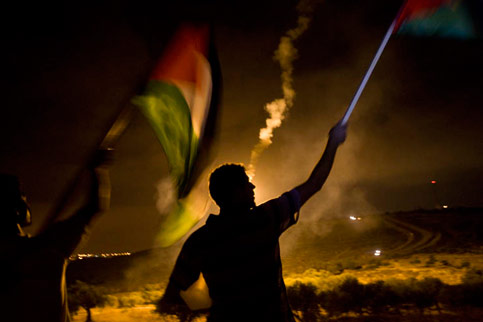
palestinian non violent resistance to occupation

Palestinian non-violent resistance to Occupation

Larry Derfner wrote a suggestive column in the Jerusalem Post about what he hopes is the coming Palestinian democratic revolution.  AP’s West Bank reporter also traces developments on the ground there.

All this got me to thinking about how such a thing might happen.  Before I lay out my ideas I want everyone to understand that I do this not as a Palestinian, so I assume a certain humility in suggesting that others do things based on my own vision of how a Palestinian non-violent revolution could evolve.  I’m also aware that what Larry and I suggest in both our pieces may end in the death or maiming of Palestinians.  The only thing that heartens me about this is that such sacrifices will bring their people closer to realizing its national dreams and also ending an Occupation which is disastrous for the Israeli people as well.  What I hope to do is start a dialogue with my Palestinian and Israeli brothers and sisters.  It may be that what I suggest below is useful.  It may not be.  “You take what you need and leave the rest” as The Band used to sing.

While I admire Larry for his courage in being one of the lone lefty columnists at the Post and for the power of his voice, I think his column omits some critical differences between the Palestinian condition and those of other Arab nations where protests have toppled, or threaten to topple a powerful dictatorial elite.  These differences render a potential Palestinian revolution much more complicated.  First, you have two Palestinian populations, one in Israel which faces huge levels of disenfranchisement and discrimination; and another in Palestine which faces severe fragmentation given the alienation between Hamas and Fatah.  While both populations would benefit tremendously from such a movement for true democracy, their conditions and needs are quite different.  Israeli Palestinians need equality within Israel’s political and economic system.  Palestinians of the Territories need to rid themselves of the Occupation regime and gain sovereignty over their own land in an independent state.  While there are elements that tie these two conditions together, they are not the same and this complicates the situation for those seeking radical change.

Second, the Arab revolutions of Egypt, Tunisia, Yemen, Bahrain, Libya, etc. are indigenous revolutions within a discreet country in which the masses have arisen against their own leaders.  Palestine, on the other hand is occupied by an outside nation, Israel.  While the PA and Fatah are largely discredited politically, I don’t see any evidence that the masses of West Bankers are eager to chuck Fatah, nor do I see Gazans seeking to topple Hamas.  The problem for Palestinians (at least as they see it) is not so much their own leaders as Israel itself.  Yes, Palestinians need democracy and unity.  They need new elections and to be ruled by a single, coherent government in the form of a PA that includes both Fatah and Hamas and other political groupings.  But besides this indigenous political problem, there remains that 900 pound gorilla, Israel.

This makes the Palestinian revolution that much more difficult since they seek to topple not their own leaders, but an Occupation regime which Israel has installed and maintains.  So to an extent Palestinians will need to enlist the support of Israelis themselves and to a greater or lesser extent the outside world to dismantle this system of oppression.  This makes their task almost insurmountable in my opinion given that Israel shows absolutely no interest in doing so and world powers are equally disinclined to intervene forcefully.

Building on some of the elements of Larry’s column, here are some of my thoughts about how to create a Palestinian revolution:

Within Israel, Palestinians should attempt to build a mass movement that will formulate a few basic, easy to understand demands.  Then, following the example of Egypt, Tunisia and Bahrain, hundreds of thousands should march from their villages to Tel Aviv, Jerusalem and Haifa and occupy Rabin Square (Tel Aviv), Tzion Square (Jerusalem) and a similar central location in Haifa as Egyptians did Tahrir Square.  Israeli Bedouin should prepare to march en masse on the Negev villages from which they’ve been displaced.  Israeli Druze should mass in the Golan for reunification with their families on the Syrian side of the border.  Gazans should mass at the Israeli border crossings and demand their opening and the end of the siege.

menachem froman with korans for burned mosques

Rabbi Menachem Froman bears new Korans for burned Palestinian mosque

Israeli Jewish activists have a role to play here as well.  Instead of demonstrating only on Fridays at Sheikh Jarrah, they must create massive encampments to blockade the settler enclaves there which have dispossessed Palestinians from homes they’ve occupied for generations.  I would like to see Israeli Jews and Palestinians linking arms as Dr. Martin Luther King did in Selma with Rabbi Abraham Joshua Heschel.  Let’s see the forces for change led by Rabbis Menachem Froman and Arik Aschermann on the Israeli side and non-violent Palestinians like Mustafa Barghouti on the Palestinian.  Let’s call it the March Toward Freedom or something of the sort.  Let us dare the forces of repression to confront us and then allow the world to judge who is right and who is wrong.

American Jews have a role as well.  Jewish Voice for Peace, American Friends of Peace Now and other anti-Occupation forces should prepare to lobby strenuously for U.S. intervention to maintain the peace and end expected Israeli violence.  If prevailing assumptions are derailed by this massive resistance, then the consensus to maintain the status quo may be undermined.  Openings for new ideas and bold action can be created by such an explosive crisis.

Again, there are severe obstacles facing Israeli Palestinians that did not face Egyptians.  The latter regime was undemocratic, corrupt and sclerotic.  Israel is a quasi-democracy and at least nominally responsive to its citizens.  Its security apparatus is far more robust than Egypt’s.  No Israeli police will refuse to fire on demonstrators if ordered to do so.  No military personnel will mutiny and join the resistance.  Israel’s security forces will be disciplined and implacable.  There is no overtly corrupt elite on which the recruits will turn.

I have no doubt that Shabak will react harshly to any plans of the sort I’ve outlined.  They’ll arrest leaders en masse before such a plan gets underway (which is why it would be important to follow the Egyptian model and not have a single leader or even group of leaders–this much be a mass, decentralized movement).  The police-intelligence apparatus will mobilize huge levels of force to prevent such a march and they’ll do everything in their power to prevent Israeli Arabs from reaching their destinations.  The resistance should designate secondary targets if they are prevented from accessing their primary ones.  They should bring their tents and provisions and prepare to stay for the duration or until they are assaulted by the security apparatus.

Even if they fail, I think the level of brutality used against them will severely tarnish Israel’s reputation.  With each new massacre, with each war, with each new challenge to the Israeli system, the contradictions and inequities become ever more apparent.  Whatever the outcome of this effort, it will continue a progression toward an elemental, even existential crisis, an ongoing process of fragmentation of Israel’s dysfunctional political system.

As for Palestine, the strategy here must be different.  Palestinians must target more directly the symbols and presence of Occupation.  They should identify several key settlements (Ariel would be one) and mass hundreds of thousands to gather around them and lay non-violent siege to them.  This would be a perfect mirror of what Israel is doing to Gaza and I imagine would cause an immediate end to the Gaza siege.  Unlike in Gaza though, I don’t advocate starving settlers.  Rather their daily lives should be severely disrupted.  Their contact with the outside world (Israel) should be severed.  They should not go to work.  They should not leave their settlements.  They should not have electricity or telephone or television.  They should be made to feel how isolated they are.

If the IDF wants to break such sieges with violence then go right ahead.  A non-violent siege broken up with massive levels of violence would further and perhaps fatally wound the Occupation as a viable concept in the eyes of the world and perhaps even the most die-hard Israelis.

The Bilin protests against the Apartheid Wall should be escalated.  They should be brought to multiple villages which face losing access to their fields and land.  Palestinians should rally at places where the Wall isn’t complete and non-violently demand its dismantling.  If possible they should enter Israel, sit down just across the Green Line and symbolically occupy a few meters of Israeli territory.  Again, given the levels of brutality the IDF and Border Police have used against Bilin demonstrators I have little doubt that they would continue with such a policy of suppression.  However, if there were tens of thousands at these protests instead of hundreds as there are now, it would be much harder for Occupation forces to disrupt them.

Palestine is ripe for such a process of radical democratic change.  The question is how Israel will react.  Whether it will show the true ugly form of Occupation to the world, or whether it will succeed in finessing such a crisis and defusing it with little damage to its reputation.  If, as I believe is possible, Israel reacts with enormous levels of violence, this could sow the seeds of intervention by the international community to end Israel’s domination of Palestine.  It could set the state for a radical transformation both within Israel and Palestine.

What are the chances of this happening?  What were the chances on January 24th that Egyptians would topple the Mubarak regime?  You’ve got to start somewhere. And as the current Arab movements for change have shown, you’ve got to think big.  And you’ve got to try.  Just because you’ve failed 100 times before doesn’t mean the 101st time you’ll fail again.

The Israel Project on Arab Revolutions: ‘Good for the Jews?’

Monday, February 28th, 2011

The Forward brings to us one of the most unintentionally funny articles of the week exploring how the Israel lobby is trying to get the Arab democratic revolutions to work for Israel, rather than against it.  Jennifer Lazlo-Mizrahi, one of Israel’s premier enablers in the nation’s capital, as usual espouses some wonderfully outrageous views:

“We need to look at the opportunity and the promise,” said Jennifer Laszlo Mizrahi, founder and president of The Israel Project, which has been among the very few groups to engage in outreach to the Arab world. “We need to ask how can we make it good for the Jews.”

In the meantime, pro-Israel activists are getting used to a new language when communicating with the Arab world. It includes stressing the financial benefits of peace and the shared value of freedom. At the same time, it ignores the ongoing conflict with the Palestinians. Israel, in this new public diplomacy reality, is no longer referred to as the “only democracy” in the Middle East, but rather as the “most stable democracy” in the region, pro-Israel activists said.

You should never underestimate the Lobby’s tendency toward irrelevance when it comes to having anything real or probitive to say on any issue concerning Israel.  And they haven’t disappointed here either.  When facing the most momentous development in world history since 1989, all Mizrahi can ask is whether it’s good for the Jews.

And isn’t the new slogan “most stable autocracy” er, democracy in the Middle East a howler?  I am glad though they’re finally giving up the “only democracy” slogan since it’s been a lie since Turkey and Lebanon elected democratic governments.  Do you think if The Israel Project is finally giving up this hoary old piece of hasbara that commenters here will too?

One should ask though what a “stable” democracy means when said democracy presides over 40+ years of illegal Occupation of the lands of another people and refuses to compromise with this people in order to allow each to live in peace with the other.  Is this what stable democracies do?

UPDATE/CORRECTION: Laszlo Mizrahi apparently discovered another website which republished this post and she published the following comment there.  I’m sorry to find that she’s deeply hurt by the mean, mean things I said about her and TIP above.  This grieves my heart so.  I really, definitely plan on begging her forgiveness sometime very soon.

Here’s her comment:

Your work is so careless that you can’t even seem to spell my name correctly or figure out who I am married to (hint — NOT an Israel OR a diplomat). Time and again you belittle our peace work. Mean, mean, stuff — that is devoid of facts. Well, feel free to poke at us again and again. It will not sway us from working day and night for peace and a better future for BOTH sides! Don’t believe me? Go to theisraelproject.org/peace.

And btw — when was the last time YOU were in Ramallah or any other part of the West Bank? I go and I care.

Let’s correct a misimpression first.  I spelled her name correctly in the above post, but the blogger who republished it introduced the error in spelling her name.  Not my fault.

I did write in an earlier version of this post that Laszlo Mizrahi is married to Israel’s deputy chief of mission in the Washington DC embassy.  Actually, Laura Kam, TIP’s “senior advisor for European Affairs” is married to Jeremy Issacharoff, the paid-hasbarist–er, diplomat in question.

I would really, really like to know the last time Laszlo Mizrahi was in Ramallah and I’d really, really, really like to know when she plans to get to Gaza.  That should be quite a event.  They’ll roll out the red carpet for her I’m sure.  And since she’s SO dedicated to peace “for BOTH sides!” I’m sure she plans on visiting soon.

As for me, I don’t have big, fat moneybags bankrolling my propaganda efforts as she does, so it’s a bit hard for me to get out and about and halfway around the world.  But I’ll make her a deal, if she springs for it I’ll arrange a wonderful visit to Gaza where we can both go and study peace efforts and a “better future for BOTH sides!”  I’ll even throw in a visit to Bilin for a Friday demonstration for good measure!

Israeli Public Inquiry: Shehadeh Assassination Justified

Sunday, February 27th, 2011
salah shehadeh

Salah Shehadeh and the sophistries of Israel's public inquiry into his murder

In 2002, after a smaller bomb failed to murder Salah Shehadeh, then Hamas military commander in Gaza, the IAF dropped a 2,000 pound bomb on a residential apartment building killing him and his entire family: 13 civilians in all along with tens of seriously wounded.

The Israeli NGO Yesh Gvul charged the IDF officers who planned and executed the attack with violations of Israeli and international law and filed a case with the Israeli Supreme Court.  In response, the Court asked the government to create a public commission to examine the charges.  The case languished for several years while various governments dithered about naming members of the commission.  Yesh Gvul went back to court and it finally commanded the government to create the board, which Ehud Olmert did in 2008.  He originally appointed Brig. Gen. Tzvi Inbar to chair the body, to whom he added Gen. Yitzhak Eitan and senior Shabak officer, Yitzhak Dar.  After Inbar’s death, Bibi Netanyahu appointed retired Judge Tovah Sternberg-Cahan to head the board.  I’ll leave it to you to judge whether this was a truly independent and fair investigation.

It’s only taken three years, but the group has finally figured out how to successfully white-wash the crime (English version) in its final report.  The thinking is so perverse, the language so bureaucratically chilling and morally vacuous, that it’s worth quoting extensively from the Walla artcle (which also quotes the lanugage of the report):

Nine years after the assassination of Salah Shehadeh, a special commission found it unnecessary to take personal action against those [IDF officers] involved in the operation.  With that, the commission found that the murder of 13 civilians was “disproportionate and derived from an intelligence failure.”

The commission…determined that there was no legitimate suspicion of commission of a criminal act connected with the operation…It found the operation was a “legitimate preventive attack” and that killing Shehadeh was an “urgent and meaningful.”

It attributed the intelligence “failure” to ‘errors of evaluation’ and ‘mistakes of judgment’ in gathering information and distributing it to various elements involved in the operation.

Those IDF officers charged with involvement in the incident explained the “gap” by noting the need for urgent action once it was determined that Shehadeh was vulnerable to attack.  The commission responded that such reasoning “explained the failure but didn’t justify it,” whatever that means:

The intelligence failure emanated from various reasons which attached more important to killing the target and less weight to ‘endangering’  civilians as a result of this attack…This accompanying result [killing civilians] was unintentional and unexpected.  It did not derived from a disrespect for human life or [depraved] indifference to human life.  Those involved displayed a sensitivity to the issue of [harm] to those uninvolved.  Those engaged in the operation testified to the commission that had they known the severity of the outcome beforehand and with enough time to do so, they would’ve cancelled it.

The board specifically commended then deputy chief of staff , Gabi Ashkenazi, for opposing the killing using the operational plan that had been approved.  Even those who opposed the operation acceded to their superiors and participated in the killing.

The commission advised the IDF how to proceed in future when devising similar plans:

Proportionality is an important principle from which one derives that an attack of this sort is not legitimate if the danger of excessive harm to civilians exceeds the military value of the target.

However, it even permitted a loophole from this protocol by admitting that there may be instances in which pressures of time, place and opportunity which apply to pre-emptive strikes:

In such instances it is permitted to deviate or restrict adherence to such principles except insofar as they might damage principles of law and the precedents of the Supreme Court.

The board’s report approved the continuation of the IDF’s policy of targeted killing:

Despite the result in this case, pre-emptive attacks are a legitimate tool in the war against murderous terror as long as they adhere to the principles of justice and the ethical-moral values that serve as the foundation of Israeli and international justice.

Yesh Gvul has announced that it will appeal to the Supreme Court and ask for the appointment of an official government commission of inquiry.

A few comments on the passages above: any IDF officer who testified that army intelligence didn’t know civilians were in that apartment building or didn’t know civilians would be killed in the attack was lying.  The bomb dropped was specifically designed to destroy the entire building (as it did).  The IDF knew of Shehadeh’s every movement, and certainly monitored his stay in his own home along with the presence of any resident in the building.  To say they didn’t know who was there is simply preposterous.  I expect the military to lie.  But I don’t expect judges to accept such lies wholeheartedly.  But unfortunately this is customary in many national security cases.

But why should we be surprised?  Israel’s Occupation itself is built on a lie.  A lie which many Israelis willingly accept and benefit from in their everyday lives.  Should it surprise us that Israeli officers would lie in order to protect the honor of the IDF and the state it defends?

It’s also important to note that at the time of the assassination the leading Fatah and Hamas figures, Marwan Barghouti and Sheikh Yassine, had agreed to a formal unilateral ceasefire with Israel. The latter’s agreement to the declaration came only two hours before the assassination of Shehadeh.  Israel’s claim all along was that militants controlled the PA and any agreement that omitted them wouldn’t be worth the paper on which it was written.  To that, the Palestinians responded by enlisting the very “terror” groups needed to ensure the success of the ceasefire.  Their declaration was unilateral and unequivocal.  Newspaper articles were being prepared for publication in the Washington Post and Haaretz to herald this constructive development.

Israel’s answer was a 2,000 pound bomb on Salah Shehadeh’s home, thus destroying one of the most promising attempts of the era to negotiate peaceful terms between Israel and the Palestinians.  This is how the military-intelligence apparatus deals with opportunities for peace.  It wrecks them.  Deliberately.  And then takes whatever small amount of heat may come its way.  The heat is worth the danger of serious peace negotiations, which would rock the status quo the IDF finds so comfortable.

International law is predicated on giving an opportunity to nation states to first adjudicate violations that occur on their territory or at the hands of their representatives.  Israel’s attempt to do so has failed.  This leaves the International Criminal Court and other international bodies with no recourse but to agree to accept jurisdiction over this matter.  Israel engaged in a shameful whitewash that has excused all military personnel of any culpability.  But the world community must not let Israel’s military to escape with impunity.

J Street and the Death of Liberal Zionism

Sunday, February 27th, 2011

At first glance, it may appear downright curmudgeonly to speak ill of J Street as it triumphantly open its second annual conference.  I attended its first conference in 2009 and hosted an unofficial progressive blogger panel there.  Since then I’ve had a testy relationship with the group which has eventually led me to sever ties with it.  One of my initial disagreements involved its decision to exclude Jewish Voice for Peace from the first conference.  It also excluded Michael Lerner of Tikkun Magazine.

The second time around they’ve embraced some of the previously excluded in ways tentative or hearty depending on how closely they embody the liberal Zionist ethic the group represents.  New Israel Fund, Peace Now and Tikkun Magazine have each received their own panels to showcase their work.  Jewish Voice for Peace, however, hasn’t quite come in from the cold.  Its director, Rebecca Vilkomerson, will participate in a BDS panel with three opponents of the concept.  Jeremy Ben-Ami made some typically condescending comments to Washington Jewish Week in which he reassured mainstream Jews not to worry about Vilkomerson’s views infecting the J Street body politic because merely hearing them at the conference would prove to listeners the error of JVP’s ways:

Ben-Ami…said he is not concerned that the appearance of Vilkomerson might legitimize BDS. Rather, she was invited to air her views, he explained, so that conference attendees who might be “tempted” to embrace BDS will think otherwise after they see its moral and tactical failings exposed in debate.

This is the condescending, dismissive, litmus-test-driven J Street which drives me up a wall.  The Israeli-Arab conflict should be beyond ideology.  It should be beyond deciding for the parties how many states there should be.

I’ve reviewed the speakers and generally (with a few exceptions) I find the American speakers are standard issue liberal Zionist fare including figures like Dennis Ross, Peter Beinart, Gershom Gorenberg, Bernard Avishai, Ken Bob, Daniel Sokatch, Daniel Levy, and David Saperstein.  [UPDATE: a characteristically thin-skinned Gershom Gorenberg  writes to complain that he is Israeli, though interestingly doesn't reject the "liberal Zionist" label.  The fact that Gorenberg was born in the U.S., retains U.S. citizenship and earns a considerable portion of his living in and from the U.S. seems to have been lost on him.  But I promise I'll call him an Israeli-American liberal Zionist next time.]  But the Israelis are a different story.  There are of course the typical Israeli pols, Knesset members who bring little to the table except the ability to flatter J Street that it is hobnobbing with the Israeli power structure.

But there are several young Israeli leaders of the Sheikh Jarrah movement who will speak, notably Assaf Sharon and Sara Benninga.  Also, there is Daniel Seidemann of Ir Amim, Michael Sfard of Yesh Din, Jessica Montell of B’Tselem, Oded Naaman of Breaking the Silence.  This shows that J Street has at least recognized that they represent something vital is Israeli dissident politics.  However, the group’s leaders have over-romanticized the Israeli movement and freighted it with far too much significance.  There is a tendency among the liberal Zionists to view Sheikh Jarrah as the Great White Hope for revival of an Israeli left.  J Street is no exception.  Note that it’s titled the panel on which the Israelis will appear: The Revival of the Israeli Left. Sheikh Jarrah isn’t the revival of the Israeli left.  It is a successful political concept which most likely cannot be grown into a national movement because of its inherent limitations, which make it good at what it IS doing.

An added problem for J Street is that while the Sheikh Jarrah movement is just about the only bright spot on the Israeli left, it is decidedly not liberal Zionist.  So what is left of the Israeli left may appear at this conference, but J Street will find that the Israelis are much closer in spirit and independence to Jewish Voice for Peace than J Street.  What is exciting about Sheikh Jarrah is that it doesn’t toe a party line.  It doesn’t call for an any state solution, one or two.  It is a single issue group and that is it’s power.

J Street has included precisely three Palestinians in its conference program (and two Palestinian-Americans).  One of the former is Dr. Izzeldin Abuelaish, who tonight delivered his powerful words of faith and hope.  But a Jewish peace group has to do better than including a smattering of Palestinian voices in its deliberations.

A number of people I like and respect like Matt Duss, Didi Remez and Mitchell Plitnick are either participating in the conference or blogging hopefully about it.  While I continue to admire them I think ultimately they’re wasting their breath. J Street is an empty shell. Yes, they run a good conference.  But what are they when they’re not running a conference?  Where are they on the issues?  All over the place.  They were for Cast Lead till they were against it.  They were for and against the Goldstone Report, a pretty neat trick.  They were against Iran sanctions till they were for them.  Jeremy Ben Ami wasn’t taking George Soros’ money till he was.  They have an identity crisis.

Jeremy Ben Ami specializes in the old Clinton triangulation strategy.  You tack straight down the middle between right and left.  By doing so you gain the respect of the broad middle that eschews tags of extreme ideology or partisanship.  But there’s one big problem with this approach.  There is no “broad middle” that remains in either the American Jewish community or Israel.  There is the far right, which is dominant and the left which is largely quiescent.  So by hewing to a middle road you essentially satisfy very few.

J Street is also a lobbying group that supports liberal Democrats who support Israel and peace.  They contribute substantial funds to Congressional candidates.  But frankly, I don’t see this as being where the action in regarding either the Israeli-Arab conflict or even U.S. policy toward Israel, just as I see the Knesset as an irrelevant institution to political decision-making within Israel.

J Street is largely a cheering section for Obama administration policy in the Middle East.  It is true that it lobbied against a veto of the latest UN Security Council resolution against settlements.  But it lost that round.  And one could argue that the abject failure of Obama’s strategy for Israeli-Palestinian negotiations has left J Street with no horse on which to bet.  The group would have to stake out some independent ground since Obama has been shown to have nothing to offer.

Liberal Zionism is dead and J Street is liberal Zionism personified. It’s like the Sean Penn character in Dead Man Walking.  While it isn’t precisely dead, it is close to being irrelevant.  And in politics that’s as good as dead.  J Street abandoned us.  It is too timid to represent real change or a hopeful message for the future.  It waffles.  It fudges.  It performs ideological litmus tests to determine who’s welcomed inside the tent.  And anyone who believes it represents something vital or hopeful in the long-term is deluding him or herself.

While some may think I’m being overly harsh with J Street if they feel about it as I once did–that it represents a potential for something new in the American Jewish community.  But the truth is that J Street will either eventually embrace ideas it currently labels anathema, or it will rapidly become irrelevant.  Given what I’ve seen, I don’t see it taking the kind of bold positions that are vital to encourage real change on the Israeli political scene.  Israel needs tough love and Jeremy Ben Ami offers parve.

Settlers Call for Palestinian Expulsion, Palestinians Call for Jewish Expulsion

Friday, February 25th, 2011
palestinian expulsion ad

Aryeh Eldad's radical settler proposal to expel Palestinians to Jordan

In a game of tit for tat, battling Israeli Jewish and Palestinian groups have called for forced expulsion of their opposite number from their native lands.  Aryeh Eldad, a radical settler leader and Israeli MK has published an ad in Haaretz which calls for Jordan’s King Abdullah to accept the millions of Palestinians living within Israel and the Occupied Territories to be expelled to Jordan, their “rightful home” (according to Eldad).  Though according to whose ‘right’ it’s not clear.

Likewise, a radical Palestinian group has called for the forced expulsion of all Israeli Jews from their own native land, Israel, to the lands of their forefathers in Europe and the far-flung Jewish Diaspora.  This seems only fitting if one side is going to advocate forcibly expelling the other that the opposing side do the same.  That way, no one would remain in the land and it could then be settled by a yet a third people (perhaps the Jebusites, Moabites, Emorites or another tribe exterminated by the ancient Israelites during their habitation of the land) looking for a land without a people for a people without a land.

In all seriousness and with sadness, I report that the first paragraph is truthful, while the second is fiction.  It is true that some pro-Palestinian activists advocate Jews leaving Israel, but they’re hard to take seriously.  However, the settler advocacy for Palestinian expulsion has been seriously advocated by prominent figures in the Israeli political right and center (Benny Morris among them) for decades.  As recently as 1989, Bibi Netanyahu himself publicly advocated this view, though he’s much too slick these days to ‘fess up to his original sin.  Polls have found that 40% of more of Israelis view transfer as an attractive solution to the “Palestinian problem.”  In short, racism is alive and well on the Israeli far-right, which has basically become the Israeli center as the former center has disintegrated.

An interesting sidebar: the Roman destruction of the Second Temple is called the Hurban (a Hebrew term for “destruction” on a cataclysmic scale) because it led to the end of Jewish sovereignty in Israel and the scattering of Jews to the winds in the Diaspora.  Similarly, the 1948 Palestinian expulsion from the land is called the Nakba (or “catastrophe”).  One of the themes of this blog is to show each people that the other has mirrored their experience, history, and suffering, in an attempt to compel mutual recognition and empathy.  Perhaps neither will be able to acknowledge these parallels for some time, but eventually they will.  That is why I like Dr. Izzeldin Abuelaish’s characterization of the Israeli Jewish and Palestinian peoples as “conjoined twins who will live together or die together.”  We may not be ‘One’ as the old UJA slogan used to hold, but “we are all together” as the Beatles once sang.

Haaretz Profiles Shabak Director-Designate

Friday, February 25th, 2011

Several months ago, I posted here news from an Israeli source of the designation of Yitzhak Ilan, 54, to be the next Shabak chief.  Israel’s media cannot report his name as it is under gag (the rules state that no one under the rank of agency director can be named publicly, even if they’re long dead).  But his identity is known to most of Israel’s reporters.  Amir Oren profiled Ilan in today’s Haaretz, showering him with praise from current and former directors.  The headline of the story, Who Laughs Last in Shabak, alludes to Ilan’s first name, Yitzhak, deriving from the Hebrew root meaning “to laugh.”  The profile appears to be part of a carefully wrought coming-out party to the Israeli public for the director-to-be.  Part of burnishing his reputation in the mind of the body politic.

Ilan, currently living in Ashdod, is an immigrant from the Republic of Georgia, who came to Israel in 1973.  Oren somewhat ominously notes that Ilan will be the most powerful Georgian ever to have run an intelligence agency since Lavrenti Beria headed the NKVD in Stalin’s (another Georgian native) time.

Ilan joined the Shabak in 1982, recruited for his obvious skills in targeting Soviet spies.  After some time, he apparently surprised his bosses by informing them he wished to change his assignment to the Arab sector, considered more “central” to the function of the spy agency.  His superiors were reluctant to “waste” his native talents with such a move, but Ilan insisted.  He learned Arabic, which became his fifth language after Hebrew, Georgian, Russian and English.  He was assigned to investigations, but his then-boss, Avi Dichter, moved him to field work.

Among the accolades showered on Ilan by his former bosses are: sophisticated, creative and master of trickery.  Dichter raves:

His character, astonishing.  Talented as the devil.  Learned in the sciences.  A wonderful family.

Among the projects in which he ‘distinguished’ himself in his field work in the southern command were the assassinations of Yihyeh “the Engineer” Ayash in 1996, and the 2002 killing of Raad Carmi.  A massive series of retaliatory terror attacks followed Carmi’s murder, but Ilan refuses to see them as that.  Instead, he sees the terror attacks as the work of Carmi himself, being planned by him before his death and executed by his lieutenants.  I must note here that Israel’s intelligence operatives never concede that their violence makes matters worse and Ilan is no different in his blindness.

More recently, Ilan was the head of the Jewish sector of Shabak and as such responsible for sweeping Jack Teitel‘s crimes under the rug in the usual way Jewish terrorists are treated: he received a designation from a psychiatrist that he is unfit to stand trial.  Shabak, ever a creature of routine, follows similar scenarios in investigating and prosecuting both Jews and Arabs.  The former are usually found too crazy to face justice, while the latter are always tortured during interrogation which invariably induces a “confession,” which a judge always allows to be admitted into evidence.

Ilan, however, wasn’t so lucky in his interrogation of Chaim Pearlman, also suspected of murdering Palestinians in cold blood.  Pearlman walked and has never faced trial.  I wonder why Oren’s profile didn’t note any of Ilan’s failures?

Upon his promotion, which awaits the approval of Bibi Netanyahu, Ilan will become the first Georgian to head the agency.  He will also have risen to his position in an unorthodox way given that most Shabak chiefs come from the ranks of the IDF’s élite units.

The tragedy of latter-day Israel is that its Yitzhak Ilans are looked up to as heroes.  Where skills of torture and murder are what qualifies a man to be the head of the nation’s domestic intelligence service.  When peace eventually comes, it is the Ilans of Israel (and their Palestinian counterparts as well) who will be summoned by either a Reconciliation Commission or court to account for their crimes.

Bibi Rewrites History–and Reality

Thursday, February 24th, 2011

Bibi Netanyahu, in a Knesset speech covered by Haaretz, announced some sweeping revisions to history and Israeli-Arab reality.  For example, did you know that a Palestinian state already exists?  Sure does, according to the Beeb, who said with regard to the Arab uprisings toppling dictators right and left:

We do not know what will happen to our west, and we do not know what will happen to our east, and who can determine whether the Palestinian state – in the middle of it all – will hold on?”

This reminds me a bit of Ronald Reagan who would tell convincing stories of his war experiences in the Pacific theater during World War II, which consisted of his memories of war films in which he’d acted.  It’s so much more convenient for an Israeli prime minister to prevent the creation of a Palestinian state, and then turn around and tell his western critics that one already exists despite the fact that it may be in his mind only.

Oh, and don’t ya know that Turkey destroyed its relations with Israel solely by the attack of Prime Minister Erdogan on Shimon Peres at Davos?

Just as the de-facto peace relations that we had with one country – Iran – evaporated in a moment, just as the more official, more established relationship that even included joint military exercises and 400,000 tourists evaporated overnight when the Turkish prime minister attacked our President Peres in Davos…

There are a few small matters like the Mavi Marmara massacre and Ehud Olmert’s destruction of the Syrian-Israeli peace negotiation mediated by Erdogan, when he began Operation Cast Lead.  Those little incidents, of course, played no role in the torpedoing of Israel-Turkey relations.

Not to mention it was Shimon Peres who sputtered with rage at Davos, violating international protocol by viciously attacking Turkey and its elected national leader in a public gathering; and that this provoked Erdogan to walk out of the meeting.  And that Peres apologized afterward for his intemperance.

But hey, what’s a dose of reality among friends?  And who needs reality anyway when you can have such a delightful delusional alternate universe all for the asking?  When you’re a Likud prime minister, anything’s possible.  Next thing you know, pigs will fly and maybe even be kosher.

As I wrote in a recent post about the bloody mess unfolding in Tripoli, such mayhem is good for the Occupation business.  Proof lies no farther than Bibi’s speech to the Knesset, where he finds succor in the bloodbath, because it gives him an out as far as negotiating a peace with the Palestinians:

Netanyahu also claimed that “The entire world told us the reason for instability in the Middle East is the Israel-Palestinian conflict. We begged to differ. There is a problem here that we wish to solve, but we must take the Islamic extremists – who are spreading everywhere – into account.”

Bibi, as usual, gets his facts wrong.  The entire world hasn’t said the reason for Middle East instability lies in the Israeli-Palestinian conflict.  It has said that the reason for the popularity of Islamist extremism like Al Qaeda lies in the lack of resolution of the conflict.  Perhaps as a corollary, many of the toppled and toppling autocrats have looked favorably on Israel.  This may have played some role in their lack of popularity.  But these leaders have done far more damage to their reputations by harming their own citizens directly.

Of course, what really worries Bibi, and what he can’t say to his fellow Knesset delusionals, is that the rising democratization of the Arab world means that new governments will be listening to the will of the people and pursuing new foreign policy goals accordingly.  Thus, the free ride Israel enjoyed from regimes like Egypt, Turkey (pre-Erdogan)  and Jordan may be a thing of the past.  Israel henceforward may have to create support in the Arab world the old- fashioned way–by earning it.

Performance Optimization WordPress Plugins by W3 EDGE