Mahzor

New York Public Library

Churches

Sarajevo Haggadah

Mah Nishtanah

Sarajevo haggadah

Antaea Darom

Israeli women's art

Action

Torah as music

Ben Heine

Action

ceramic bowl

Mohammad Said Kalash, "Offering Reconciliation" exhibit (photo: Ilan Amihai)

Action

Punch and Judy/Pinchas and Jamila

Avi Katz

Action

David Grossman

Ben Heine

Action

Eldrige Street shul

Lower East Side

Action

Dove

Ben Heine

Action

Two birds

Hoda Jamal

Action

Israeli and Palestinian boys

from documentary, Promises

Action

Cat in the Hat

Yiddish version

Action

Daylight through the Wall

Banksy: graffiti art on Separation Wall

Action

Maurice Sendak's Brundibar set

New Victory Theater (photo: Nan Melville/NYT)

Action

Daniel Barenboim, West-Eastern Divan Orchestra

Palestinian-Israeli musical ensemble (photo: Kerstin Joensson/AP)

Action

Great Day on Eldrige Street

N.Y.'s klezmer greats celebrate shul rededication (photo: Leo Sorel)

Action

Joint Appeal for Peace

(Avi Katz)

Joint Appeal for Peace

Ketubah, Ancona, Italy (1772)

(Jewish Theological Seminary library)

Ancona ketubah

Archive for January, 2009

Israel Bans Arab Parties from Election, Is This Iran?

Tuesday, January 13th, 2009

You’ll have to pardon me for asking whether a decision by the Knesset’s election committee to bar two of three Arab political parties from running in next month’s elections isn’t more reminiscent of Iran than of western democracies.  The ayatollahs control who runs for the parliament and reject candidates practically because they wear the wrong color shoes and other such idiocies.  Israel isn’t far behind Iran I’m afraid:

The Central Elections Committee (CEC) yesterday banned the Arab parties United Arab List-Ta’al and Balad from running in next month’s parliamentary elections amid accusations of racism from Arab MKs. Both parties intend to challenge the decision in the Supreme Court.

Members of the CEC conceded yesterday that the chance of the Supreme Court’s upholding the ban on both parties was slim.

Arab faction delegates in the CEC walked out of the hall before the vote, shouting, “this is a fascist, racist state.”

…The CEC voted overwhelmingly in favor of the motions, accusing the country’s Arab parties of incitement, supporting terrorist groups and refusing to recognize Israel’s right to exist.

The requests to ban the Arab parties were filed by two ultra right parties Yisrael Beiteinu and National Union-National Religious Party.

Senior Labor Party figures lashed out at the party’s CEC representative, Eitan Cabel, who voted in favor of banning the two Arab parties.

This passage is filled with the most incredible set or ironies. First, the two Jewish parties who brought the complaint themselves don’t believe in Israeli democracy. Avigdor Lieberman, the leader of one of them often says publicly that Arab leaders should be strung up on lamp posts and that Israeli human rights lawyers are kapos. Delightful stuff.

Further, the LABOR PARTY’s representative to this committee voted in favor of banning the Arab parties! If this doesn’t indicate how absolutely bankrupt that party has become, I don’t know what does.

Finally, the Arabs are accused of not recognizing the state of Israel yet they are duly chosen members of Knesset.  You’d think if they didn’t recognize Israel their first decision would be to boycott Knesset.  Balad is accused of supporting terrorist groups because it has sent Knesset members to visit Syria and Lebanon and met with Hezbollah.  A few right wingnuts tried this on Nancy Pelosi after she met with Bashir Assad in Syria.  They wanted to try her for violating the Logan Act.  That idea went far.  But there’s a difference between the Wall street Journal advocating sheer lunacy and a duly authorized committee of the Knesset voting to eradicate the voting rights of much of the Arab minority by wiping their chosen parties from the election rolls.

And make no mistake, the flag-waving patriotism of most Israelis in the face of its savagery in Gaza is what motivates this Israeli racism against its Arab citizens.  Israeli Jewish politicians see no downside in attacking the rights of the non-Jewish minority.  After all, it’s open season on anyone within Israel even remotely associated with Hamas.  If  you love Israeli democracy this should be damn scary stuff even if the Supreme Court undoes this travesty.

Thanks to Assaf Oron for noting this story.

Blinding the Children: Israel and White Phosphorus in Gaza

Monday, January 12th, 2009
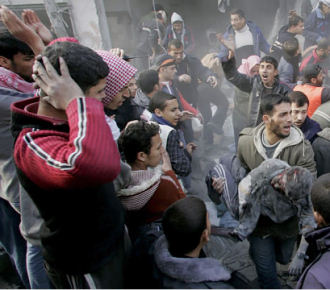
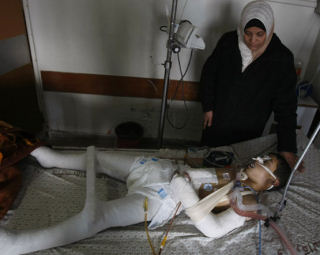
Wounded Gazan girl brought to hospital (Mohammed Abed/AFP-Getty)

Wounded Gazan girl brought to hospital (Mohammed Abed/AFP-Getty)

“Entirely consistent with international law,” says the IDF PR flack, of Israel’s use of white phosphorus in Gaza’s streets. Does international law countenance the use of such a weapon in an urban war zone densely populated by civilians? Of course not.

Here’s how the Times reports the story:

Palestinians interviewed in Gaza on Monday cited…Israel[i] soldiers…firing rounds of a noxious substance that burns skin and makes it hard to breathe.

A resident of southwest Gaza City on Monday showed a reporter a piece of metal casing with the identifying number M825A1, which Marc Garlasco, a military analyst with Human Rights Watch, identified as white phosphorus, typically used for signaling, smoke screens and destroying enemy equipment.

In recent years, experts and rights advocates have argued over whether its use to intentionally harm human beings violates international conventions.

This is not correct. International conventions allow the use of phosphorus on an open battlefield in which it is used as a smokescreen. However, when it used in a way that injures non-combatants it is a clear violation of international law. It may not be used in confined settings in which civilians are present.

Major Dallal would not say whether Israel was using white phosphorus, but said: “The munitions we use are consistent with international law.”

Still, white phosphorus can cause injury, and a growing number of Gazans report being hurt by it, including in Beit Lahiya, Khan Yunis, and in east and southwest Gaza City. When exposed to air, it ignites, experts say, and if packed into an artillery shell, it can rain down flaming chemicals that cling to anything they touch.

Luay Suboh, 10, from Beit Lahiya, lost his eyesight and the skin on his face on Saturday when, his mother said, a fiery substance clung to him as he darted home from a shelter where his family was staying to pick up clothes.

The substance smelled like burned trash, said Ms. Jaawanah, the mother who fled her home in Zeitun, who had experienced it too. She had no affection for Hamas, but her sufferings were changing that. “Do you think I’m against them firing rockets now?” she asked, referring to Hamas. “No. I was against it before. Not anymore.”

This is how Israel multiplies the hate arrayed against it among Palestinians and the rest of the Arab world. And can you really blame a Palestinian family placed in such a situation? Pro-Israel Jews speak as if Hamas’ antagonism springs from some deep-seated religious hatred going back generations or millennia. No, it springs from incidents like this one multiplied a hundred or thousand-fold. Israel creates the scarred, the blind, the lame and the martyrs. Then they turn and wreak their havoc on the country and world which did this to them. Vengeance is not just the Lord’s. Sometimes it is the crippled’s or the tortured’s.

What Ethan Bronner Won’t Tell You About Israeli Support for the Gaza War

Monday, January 12th, 2009

In the past, I’ve noted that Ethan Bronner’s reporting from Israel gets most of it right. But he only gets 85% of the way there. He misses out on the remaining 15% of the nuance of Israeli society and its political interplay. You read him and you say: “yes, but…” He’s got most of the story. But something vital, and it’s hard to put your finger on what it is, is left out.

Today’s story on the supposed unanimity of Israeli support for the war in Gaza is a case in point. Let me start by acknowledging there is no doubt that Israeli support for the war is high. And this is to be expected. There is always a high level of cohesiveness and patriotic fervor at first when Israel goes to war. But after that initial euphoria, the spell usually begins to wear off and one begins to see chinks in the armor.

Bronner argues that this hasn’t happened. That Israel has remained surprisingly unified in the face of almost universal international opprobrium with the suffering inflicted on Gazans. There are a few things to say abut this. First, the war is only two weeks old and at this point in the Lebanon war support was still high. Yet such support largely evaporated after another two weeks of war.

The major difference between Lebanon and Gaza is that Hezbollah had the fire power to inflict serious casualties on Israeli civilians and soldiers. Hamas does not. And the hard cynical fact is that Israelis will not crack unless they pay a price. Only the loss of 3,000 soldiers in the 1973 War made Golda Meir realize she’d made a mistake when she’d turned down Sadat’s offer to talk peace before the War. The loss of hundreds of young boys in southern Lebanon after the 1982 war forced Ehud Barak to conclude in 2000 that Israel’s occupation no longer made any sense. That is one reason I fear Israelis have not been willing to take stock of the real costs of this war to Palestinians and their own moral standing in the world.

I take strong issue with Bronner’s choice of Israeli news outlets which he uses to prove his point. We only hear about the pages of the Jerusalem Post and its editor. Thus, all seems well in the land of milk and honey:

As the editorial page of The Jerusalem Post put it on Monday, the world must be wondering, do Israelis really believe that everybody is wrong and they alone are right?

The answer is yes.

…“It is very frustrating for us not to be understood,” remarked Yoel Esteron, editor of a daily business newspaper called Calcalist. “Almost 100 percent of Israelis feel that the world is hypocritical. Where was the world when our cities were rocketed for eight years and our soldier was kidnapped? Why should we care about the world’s view now?”

…“This is a just war and we don’t feel guilty when civilians we don’t intend to hurt get hurt, because we feel Hamas uses these civilians as human shields,” said Elliot Jager, editorial page editor of The Jerusalem Post, who happened to answer his phone for an interview while standing in front of a house in Ashkelon, an Israeli city about 10 miles from Gaza, that had been hit two hours earlier by a Hamas rocket.

“We do feel bad about it, but we don’t feel guilty,” Mr. Jager added. “The most ethical moral imperative is for Israel to prevail in this conflict over an immoral Islamist philosophy. It is a zero sum conflict. That is what is not understood outside this country.”

While I view this argument as completely barren morally and politically, it IS a representative point of view within Israel.  The problem is that there are other views in the Israeli media as anyone reading this blog already knows.  But you won’t hear that in Bronner’s piece.  No mention of Haaretz’s editorial positions critical of the war.  No mention of commentators and analysts in both Yediot Achronot and Haaretz harshly attacking the premises of the invasion and the government’s ongoing apologetics defending it.

To Bronner’s credit, he DOES quote a few sources within Israel who disagree with the social consensus.  But he does so well into the article where their point of view becomes somewhat diminished.  But even the doubters are framed as the pitiful minority almost of one.  Bronner also neglects an important irony involving one of those critics:

Moshe Halbertal, a left-leaning professor of philosophy at the Hebrew University, helped write the army’s ethics code. He said he knew from personal experience how much laborious discussion went into deciding when it was acceptable to shoot at a legitimate target if civilians were nearby, adding that there had been several events in this war in which he suspected that the wrong decision had been made.

For example, Israel killed a top Hamas ideologue, Nizar Rayyan, during the first week of the war and at the same time killed his four wives and at least nine of his children. Looking back at it, Mr. Halbertal disapproves, assuming that the decision was made consciously, even if Mr. Rayyan purposely hid among his family to protect himself, as it appears he did. Yet almost no one here publicly questioned the decision to drop a bomb on his house and kill noncombatants; all the sentiment in Israel was how satisfying and just it was to kill a man whose ideology and activity had been so virulent and destructive.

In other words, the very ethicist who wrote the army’s vaunted moral code, has been ignored in the current conflict. Halbertal knows that both Jewish and general ethics demand a far more stringent approaching to murdering innocent civilians in pursuit of even a dangerous enemy. Yet, the army has betrayed the moral code in pursuit of its enemy. Bronner of course would never put it that way nor even note this dark irony. But it is an important part of the story and he missed it.

Bronner would’ve also done well to include this amazing first-person narrative by a Sderot resident who harshly questions the government’s rationale for the fighting.  He also seriously mischaracterizes the size of anti-war demonstrations.  Here’s what an Israeli reader reports to me:

…The opposition – marginalized as it is – is also quite determined. And Bronner grossly downplays demonstration sizes. The same day we rallied here [in Seattle], in Tel Aviv 10,000 Jews and Arabs marched. And the mostly-Arab demo he mentions took place that same day in Sikhnin…According to reports it was anywhere from 60,000 to 150,000 – certainly not 6,000.

The reporter also has a bad habit of doing what a number of pro-Israel journalists do in their reporting.  You quote a supposedly liberal Israeli figure defending the war as if this completely undercuts the entire rationale for a critical approach to Israeli policy.  In this case, Bronner quotes A. B. Yehoshua making this inane analogy to justify the war:

The writer A.B. Yehoshua, who opposes Israel’s occupation and promotes a Palestinian state, has spent the past two weeks trying to explain the war to foreigners.

“ ‘Imagine,’ I tell a French reporter, ‘that every two days a missile falls in the Champs-Élysées and only the glass windows of the shops break and five people suffer from shock,’ ” Mr. Yehoshua told a reporter from Yediot Aharonot, a Tel Aviv newspaper. “What would you say? Wouldn’t you be angry? Wouldn’t you send missiles at Belgium if it were responsible for missiles on your grand boulevard?’ ”

Yehoshua here recycles an argument used repetitively by apologists for the war. It may even have been first devised by the hasbaraniks in the foreign ministry. The only problem? Belgium would never lob missiles into the Champs Elysee because Belgium has a secure, agreed upon border with France. France has not occupied half of Belgium and starved its inhabitants into submission. France has not engaged in raids into Belgian territory at will and carried out targeted assassinations of that country’s leaders.  If France had done even half these things you can be damn sure that Belgians would be lobbing lots of things over THEIR Separation Wall with France.

Unfortunately, Bronner doesn’t have the interest or will to point out the inadequacy of Yehoshua’s logic. Perhaps Bronner even agrees with him. And that’s the severe deficiency of his reporting. He goes just so far in conveying the story to you. But he doesn’t go far enough. The analysis is bare-bones, but doesn’t really scratch the surface.

Obama’s ‘New Approach’ to Iran

Monday, January 12th, 2009

ABC This Week featured one of Barack Obama’s first major news interviews in weeks.  He covered some new ground on Iran and gave some disappointing answers on issues like Gaza.  For some reason, Obama feels empowered to strike out on his own in announcing a decisive break from Bush policy toward Iran (but not Gaza):

…We are going to have to take a new approach. And I’ve outlined my belief that engagement is the place to start. That the international community is going to be taking cues from us in how we want to approach Iran.

And I think that sending a signal that we respect the aspirations of the Iranian people, but that we also have certain expectations in terms of how a international actor behaves…

…Well, I think a new emphasis on respect and a new emphasis on being willing to talk, but also a clarity about what our bottom lines are. And we are in preparations for that. We anticipate that we’re going to have to move swiftly in that area.

This is a blessing and a relief to so many Americans who voted for a decisive break with Bush’s disastrous policies of bellicosity and threats.

On a related matter, the AP has reported that Dennis Ross is likely to be named the special Mideast envoy possibly supervising Iran and Israel-Palestine matters.  There are many in the progressive community who are concerned with this development because Ross comes directly out of the Aipac environment.  During and after Camp David in the Clinton administration he placed full blame for its failure at Arafat’s feet and refused to blame either Clinton or Barak as other witnesses to the events did.

While I share concerns about Ross, I’m trying not to let them exercise me for two reasons: first the statement above.  Obama has given a clear view of his agenda and it will Ross’ job to implement his boss’ views.  It will NOT be Ross’ job to implement his own views.  Second, I heard Rob Malley interviewed on Friday on To the Point and he said that Ross’ appointment didn’t concern him because he didn’t see Ross as a freelancer, but as a team player.  I trust Rob Malley’s instincts on these matters.

So while I have no great love for Ross, as long as he pursues Obama’s policy of engagement and negotiation over saber-rattling, I have no problem with him.

The big disappointment in the interview concerns Gaza.  Obama insists on keeping his eyes on the prize, which is an overall settlement of the conflict.  All that’s to the good.  The only problem is that the Gaza disaster could wreck any chances of getting to a comprehensive agreement in the near to medium-term due to the bitterness not only of Palestinians, but of all Muslims and Arabs. Here’s how he addressed the subject beginning with a defense of Israel’s attack:

I think a basic principle of any country is that they’ve got to protect their citizens. And so what I’ve said is that given the delicacy of the situation, the one area where the principle of one president at a time has to hold is when it comes to foreign policy.

We cannot have two administrations at the same time simultaneously sending signals in a volatile situation. But what I am doing right now is putting together the team so that on January 20th, starting on day one, we have the best possible people who are going to be immediately engaged in the Middle East peace process as a whole.

That are going to be engaging with all of the actors there. That will work to create a strategic approach that ensures that both Israelis and Palestinians can meet their aspirations.

STEPHANOPOULOS: But as you know, in much of the Arab world, your silence…has been interpreted as callousness. And we also had a viewer question on this, Marin Guerrero of Riverside, California, asks you: “Why is Obama remaining silent on the Gaza crisis when so many innocent people are being killed?”

OBAMA: Well, look, I have said — and I think I said this a couple of days back, that when you see civilians, whether Palestinian or Israeli, harmed, under hardship, it’s heartbreaking. And obviously what that does is it makes me much more determined to try to break a deadlock that has gone on for decades now.

STEPHANOPOULOS: But more broadly, will your policy in the Middle East, will it be building on the Bush policy or a clean break?

OBAMA: Well, you know, I think that if you look not just at the Bush administration, but also what happened under the Clinton administration, you are seeing the general outlines of an approach.

And I think that players in the region understand the compromises that are going to need to be made. But the politics of it are hard. And the reason it’s so important for the United States to be engaged and involved immediately, not waiting until the end of their term, is because working through the politics of this requires a third party that everybody has confidence, wants to see a fair and just outcome.

And I think that an Obama administration, if we do it right, can provide that…

So the best that Obama’s willing to give us is that the Israeli-Arab conflict will be a high priority from day one. But he refuses to tip his hand as to what even his most general philosophical outlook will be.  Personally, I think he’s rolling craps on this.  If his gamble pays off he can ride out the Gaza attack and get into the bigger picture of solving the Israel’s major conflicts with Syria, Lebanon and the Palestinians.  But if the gamble fails and the well is poisoned in the Arab world for months or more to come because of the heinousness and barbarity of Israel’s actions, then he won’t look so smart.

I think he’s missing an opportunity.  A statement that reflects sympathy for both parties while calling on Israel to ratchet down the violence and embrace an immediate ceasefire might also be a gamble.  But isn’t a gamble worthwhile when 900 Gazans have already died and the Arab world is clamoring for Israeli and U.S. blood?

If Wishing Made it So: Israel Claims Hamas Crying ‘Uncle’

Sunday, January 11th, 2009

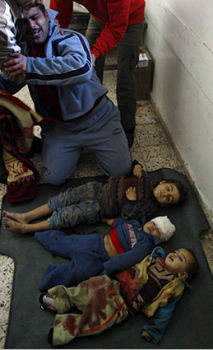
Palestinians prayed beside bodies of the Salha family killed in Israeli missile strike (Ali Ali/European Pressphoto)

Palestinians prayed beside bodies of the Salha family killed in Israeli missile strike (Ali Ali/European Pressphoto)

Operation Madness, Day 14: Palestinian dead, nearly 900, 40% women and children. Israeli dead, 13, three civilians.

It never ceases to amaze me the level of sheer wish fulfillment emanating from the Israeli intelligence establishment regarding their assessment of their Arab enemies.  Listen to these statements quoted in the N.Y. Times today:

Israeli troops pushed into a heavily populated area of Gaza City…and senior Israeli officials said for the first time in the two-week-old war that they believed that the Hamas military wing was beginning to crack and that Hamas leaders inside Gaza were looking for a cease-fire…

The Israeli cabinet secretary, Oved Yehezkel, told reporters that in the cabinet meeting the heads of army intelligence, Maj. Gen. Amos Yadlin, and of the Shin Bet security service, Yuval Diskin, said, “It is the inclination within Hamas to agree to a cease-fire, given the harsh blow it received and given the absence of accomplishment on the ground.

…“I can say with a high level of confidence that for two days, what we have been hearing repeatedly is that Hamas inside Gaza is eager — eager — to achieve a cease-fire,” said the senior official, who spoke on condition of anonymity because of the issue’s delicate nature. “This is as opposed to the leadership in Damascus that is willing to fight to the last Palestinian.”

The Israelis were clearly all pushing a concerted message, but no official provided details on how Israel supported its assertion. It was impossible to get a response from Hamas leaders in Gaza, because they were in hiding from Israeli military strikes.

Israeli intelligence reminds me of the con man who thinks that if he says something convincingly enough and often enough his listener will believe him. And surprisingly many people are conned by such people. The reporters, though they dutifully reported the story left themselves an out in recognizing that Israeli officials have a tendency not only to attempt to snow the world media, but apparently to snow themselves (if they believe what they’re saying).

The only hopeful interpretation of this malarkey is that perhaps Israel makes this claim in order to prepare its own people for a near-term ceasefire.  If they can convince the nation that it is Hamas clamoring for a ceasefire and ready to say “Uncle,” then it is easier to climb down from the precarious branch onto which they themselves have crawled.

I have said this any number of times and will say it yet again. There IS no way Israel can defeat Hamas short of occupying every square inch of Gaza and remaining there in force to prevent Hamas from reasserting itself. Hamas knows that no matter how severe the losses it must endure, it can only win. Even losing is a win as long as it survives.

Hamas, as Hezbollah before it in 2006, has emerged as the lions of resistance to Israel. Islamists the world over are lining up to do whatever they can to help Hamas. Israel’s assault throws Hamas ever more firmly into Iran’s embrace. This is a perfect storm for U.S. Middle East policy. Add this to the devastating failures we’ve endured regarding Iraq and our inability to negotiate a resolution of the Iran nuclear impasse.

On January 20th, when Barack Obama meets George Bush at the White House he’ll be tempted to quote the old Laurel and Hardy line: “That’s a fine mess you’ve gotten us into Ollie.” That is the Middle East policy Bush leaves Obama as his legacy. It’s an utter disaster.

The same report sketches out a possible ceasefire proposal.  Frankly, I’m astonished it’s taken 16 days of fighting to get a coherent report of a ceasefire proposal.  Until now, all I read from the U.S. and Israel was what they demanded from Hamas.  I didn’t hear a peep about what Israel offered in return.  So here it is finally:

Israel and the United States are trying to secure agreement on a deal brokered by Egypt that would mean a Hamas commitment to stop all rocket firing into Israel and an Egyptian commitment to block smuggling tunnels into Gaza, to stop the resupplying of Hamas with weaponry and cash. In return, Israel would agree to a cease-fire and the opening of its crossings into Gaza for goods and fuel and the opening of the Rafah crossing into Egypt, with European Union supervision.

Tony Blair, the former British prime minister and now an international envoy to the Palestinians, said in an interview that “the only way this is going to stop is if there is a genuine plan to end the smuggling into Gaza and a genuine plan to open the crossings.”

That’s good as far as it goes. But I wonder what is envisioned by “opening the crossings into Gaza for goods and fuel.” Does that mean an end to Israel’s siege? Or does it mean a continuing blockade under more beneficent rules? Further, these are almost the same provisions inscribed in previous ceasefires. Just as Israel wants to know that Hamas won’t be able to rearm & rocket southern Israel even if it wanted to, Hamas wants a guarantee that Israel can’t renege on its commitments and restore the blockade at its earliest convenience, which is what it has done in the past. In that sense, Blair’s got it precisely right.

The only way to guarantee that this works is to take it out of the hands of Hamas and Israel. The border with Egypt needs to be monitored carefully and illegal transfers need to be disrupted. If Egypt isn’t will to do this then they have to give the job to outsiders who will. Similarly, closing the Israeli crossings must not be left solely to Israel’s discretion. Monitoring the crossings certainly should be done by the Israelis, but not the decision on closing them. Again, this should be put in the hands of outsiders that both parties trust (at least nominally).

Why is N.Y. Times Reporting Now Bush Stopped Israeli Attack on Iran?

Sunday, January 11th, 2009

David Sanger published a major piece on how the U.S. related to Israel in its dealings with Iran’s nuclear program.  Though the reporter heralds it as a major piece of investigative journalism that spanned 15 months of reporting, much of the information has already been reported elsewhere (though perhaps not as well-sourced).  Sanger’s major “revelation” is that Pres. Bush refused to give Israel authorization to use U.S. weapons and controlled air space that it would need to attack Iran.  This was reported months ago in Haaretz (and by me as well).  Here’s a report about it in the NY Daily News.

Some details the Times reports were not as widely known but could probably be assumed, i.e. that the U.S. was engaging in a covert program to disrupt Iran’s nuclear activity.

Though elements of this passage are also known, they do connect the dots nicely in ways they haven’t quite been connected till now:

Last June, the Israelis conducted an exercise over the Mediterranean Sea that appeared to be a dry run for an attack on the enrichment plant at Natanz. When the exercise was analyzed at the Pentagon, officials concluded that the distances flown almost exactly equaled the distance between Israel and the Iranian nuclear site.

“This really spooked a lot of people,” one White House official said. White House officials discussed the possibility that the Israelis would fly over Iraq without American permission. In that case, would the American military be ordered to shoot them down? If the United States did not interfere to stop an Israeli attack, would the Bush administration be accused of being complicit in it?

Admiral Mullen, traveling to Israel in early July on a previously scheduled trip, questioned Israeli officials about their intentions. His Israeli counterpart, Lt. Gen. Gabi Ashkenazi, argued that an aerial attack could set Iran’s program back by two or three years, according to officials familiar with the exchange. The American estimates at the time were far more conservative.

But the big question as far as I’m concerned is why publish this now?  In one sense, the publication is timed to a book Sanger has written which will come out on Tuesday.  But in another sense, the article seems designed to take pressure off the Bush Administration regarding its effort to end the Gaza crisis.  If Bush can be made to look like a good guy for stopping Israel from bombing Iran, then maybe Americans will give him a break for letting Israel carry out a relatively harmless war on its own border with Gaza.  I don’t think anyone should be letting George Bush and Condi Rice off the hook.  Their conduct during this war has been disgraceful but totally in keeping with past lassitude.

Though Sanger does mention that Robert Gates warned Bush that a U.S. attack might create a regional war with disastrous consequences for U.S. standing and policy in the Muslim world, he does not bring any such analysis to bear in discussing the Israeli plans.  He merely states what Israel hoped to do.  It’d seem to me that if the U.S. was afraid of starting a war if it bombed Iran that Israel doing so would guarantee the possibility.  That should be worth a word or two I’d think.  But according to the article, the major concern raised by U.S. officials regarding an Israeli attack was that the U.S. might have to shoot down Israeli planes if they violated Iraqi air space.

Why I Will Not Attend Seattle’s Israel Solidarity Rally

Saturday, January 10th, 2009

On Sunday, January 11th the official Seattle Jewish community will host a “solidarity rally” for Israel at Temple DeHirsh Sinai.  The purpose of the event is to support Israeli policy and specifically its attack on Gaza.  One of the main speakers at the solidarity rally will be Nevet Basker, a board member of the right-wing pro-Israel Stand With Us.  The blue and white of the Israeli flag will wave.  The thrilling chords of Hatikvah will resound.  Pro-Israel patriotism will ring out.

Though many local Jewish organizations are co-sponsoring this event none of the Jewish peace groups here in town have been asked.  Nor would they likely have signed on.  This event DOES NOT represent all of Seattle’s Jewish community.  It represents the leadership of the Jewish community and a self-selected segment of the rest of the community.  As such, the politics represented at this event will place all blame for the conflict on the Palestinians and none on Israel.  It will justify Israel’s savage, disproportionate attack on the civilians of Gaza.  It will whitewash the death and devastation wrought by the IDF on Gaza if it will even mention it at all.  It will present the government’s position to the exclusion of any other.  It will not present any of the critical voices either in Israel itself or here in our own national or local community.  In short, Sunday promises to be a whitewash.

To be clear, while I am critical of this rally I am not critical of the Jewish community and in fact consider myself a member of it.  While I am critical of Israeli policy, I am not critical of the existence of the State of Israel.  That is why I announce my absence from the solidarity event not with a sense of satisfaction, but rather with a sense of sadness.

It would certainly not have been easy to create a program that could have truly brought the ENTIRE community together.  But I’m afraid to say that Seattle’s leaders didn’t even try.  So they will get what they paid for.  A program that represents a narrow cross section of the ideological/political spectrum.  It’s sad that it had to be that way.

That Sunday, I will be voicing my feelings about Israel’s attack on Gaza though not at DeHirsh.  I will be at Kadima’s program speaking with two other Jewish peace activists.  There we will collectively discuss our responses to the Gaza invasion.  Some guests may voice sympathy and support for Israel, especially for the innocent victims of rocket attacks.  But the major difference from the community’s program is that we will not be bound by an agenda that rejects empathy for both sides.  We will not be afraid to demand that Israel revert to honoring Jewish values which this offensive has trampled.  We will not be afraid to say that killing Palestinian civilians is a travesty that deserves the opprobrium of Jews and non-Jews everywhere.  We will not be afraid to demand that both sides compromise in achieving a workable ceasefire.

Kadima Reconstructionist Community invites you to join a discussion:

THE CRISIS AND WAR IN GAZA AND SOUTHERN ISRAEL

Judith Kolokoff, American Jews for a Just Peace
Barbara Lahav, Brit Tzedek v’Shalom
Richard Silverstein, Tikun Olam

SUNDAY, JANUARY 11, 10:30 AM– NOON

Sandpoint Education Center, 6208 60th NE, Seattle

Time: ‘Why Israel Can’t Win’

Friday, January 9th, 2009

time-why-israel-cant-winThanks to Phil Weiss for alerting me to Time Magazine’s new issue.  As Phil noted, this is big.  Time has staked its journalistic reputation on coming out four square against the Gaza attack.  It’s judging Gaza has jumped the shark.  Many of us knew Gaza had jumped the shark the moment it began.  But it took the more acute mainstream media nearly two weeks to catch up.  Now, they finally have.

In particular this passage from the cover story is penetrating:

The threat posed by Hamas is only the most immediate of the many interlocking challenges facing Israel, some of which cast dark shadows over the long-term viability of a democratic Jewish state.

And here is more wisdom:

Israel’s leaders need to recognize that if Hamas cannot be beaten militarily, then it must be engaged politically. That means accepting the idea of dealing with some kind of Palestinian unity government that includes Hamas. A coalition between Hamas and Abbas is essential for the future of a Palestinian state and for moderating Hamas’ extremism. Hamas…says it will pair up with Abbas if he, along with the international community, recognizes that the Islamic militants legitimately came to power in the January 2006 elections.

…Israel eventually will have to pull back to the 1967 borders and dismantle many of the settlements on the Palestinian side, no matter how loudly its ultra-religious parties protest. Only then will the Palestinians and the other Arab states agree to a durable peace. It’s as simple as that.

The more such simplicity is espoused in such venues as Time the closer to reality it will become.  To paraphrase Herzl: If you write it, it is no legend.

With the Guardian’s scoop earlier today that Obama will ditch Bush’s refusal to talk to Hamas and now this, the tide has really turned.  There will be growing pressure on Israel to agree to a ceasefire.  The only question is whether Hamas will get anything in return.  The world community would just as likely see this thing go away with Gaza getting no relief from the brutal 18 month siege.  I don’t know whether Hamas has the stomach to hold out for more.  I hope they do.  Israel must lift the siege.  Especially if it wants a true end of rockets falling on southern Israel.

If Israel does not concede anything meaningful to Hamas then the latter will have no reason to keep its end of the bargain.  That is why I’m hoping that Sarkozy and the UN will understand that a one-sided ceasefire will not fly.

Performance Optimization WordPress Plugins by W3 EDGE