Mahzor

New York Public Library

Churches

Sarajevo Haggadah

Mah Nishtanah

Sarajevo haggadah

Antaea Darom

Israeli women's art

Action

Torah as music

Ben Heine

Action

ceramic bowl

Mohammad Said Kalash, "Offering Reconciliation" exhibit (photo: Ilan Amihai)

Action

Punch and Judy/Pinchas and Jamila

Avi Katz

Action

David Grossman

Ben Heine

Action

Eldrige Street shul

Lower East Side

Action

Dove

Ben Heine

Action

Two birds

Hoda Jamal

Action

Israeli and Palestinian boys

from documentary, Promises

Action

Cat in the Hat

Yiddish version

Action

Daylight through the Wall

Banksy: graffiti art on Separation Wall

Action

Maurice Sendak's Brundibar set

New Victory Theater (photo: Nan Melville/NYT)

Action

Daniel Barenboim, West-Eastern Divan Orchestra

Palestinian-Israeli musical ensemble (photo: Kerstin Joensson/AP)

Action

Great Day on Eldrige Street

N.Y.'s klezmer greats celebrate shul rededication (photo: Leo Sorel)

Action

Joint Appeal for Peace

(Avi Katz)

Joint Appeal for Peace

Ketubah, Ancona, Italy (1772)

(Jewish Theological Seminary library)

Ancona ketubah

Archive for January, 2011

America’s Multiracial Baby Boom, Coming to Israel…Ever?

Monday, January 31st, 2011

The NY Times reported this week on a rising demographic phenomenon in American life: multiracialism.  One in seven new marriages in the U.S. in 2009 involved members of different races.  Multiracial Americans are one the fastest growing groups:

Many young adults of mixed backgrounds are rejecting the color lines that have defined Americans for generations in favor of a much more fluid sense of identity…

They are also using the strength in their growing numbers to affirm roots that were once portrayed as tragic or pitiable.

“I think it’s really important to acknowledge who you are and everything that makes you that,” said [Laura] Wood.

…Optimists say the blending of the races is a step toward transcending race, to a place where America is free of bigotry, prejudice and programs like affirmative action.

Warren Olney’s To the Point covered this story today.  A pollster noted that 80-90% of Americans under the age of 30 would have no problem with a close family member marrying someone of another race.  Among those 65 or older the level of acceptance was 30%.

bad faith interracial film

'Bad Faith' film poster: 'She's Jewish, he's Arab. They're expecting...'

This reminded me of a shattering annual survey of Israeli attitudes toward democracy.  46% of Israelis said they would not want to live next door to an Israeli Palestinian.  The numbers were only slightly better when you substituted “gay,” “mentally ill,” or “foreign worker.”  You can imagine what the number would’ve been had the question asked about a child marrying an “Arab.”

In this country, imperfect as race relations may be, you can see things are generally moving in a positive direction.  In Israel, not so much.  I don’t recall poll results broken down by age, nor do I recall a specific question about multi-ethnic or biracial couples, but I’d be willing to bet that there is only marginally more acceptance among young Israelis than old of this phenomenon.

And let’s not forget the learned rabbis shreying about assimilation when Arab men steal ‘our women’ and take them back to the village where they’ll be victimized, assaulted, and brainwashed in the ways of Islam.  Not to mention all the “Ahmed ben Sarah” babies they’ll be producing.

While I am proud of my Jewish identity, you have to face the fact that if you want Israel truly to thrive there must be lots more Ahmed ben Sarahs.  One of the best ways for Israeli Jews to understand their fellow Palestinian citizens is for their children to marry each other.  But think about what such couples face in contemporary Israel.  Something like the ostracism and outrage that greeted mixed race couples in America in the 1960s.

And let’s face the issue of bi-racialism.  Will it harm Jewish or Palestinian identity?  Why should it?  Not to mention: don’t we want an “Israeli identity” to emerge just as much or more than a purely Jewish or Palestinian one?  It is a fatal error to conflate “Israel” with “Jewish.”  It is and must be both.

If this troubles you overly or you’re geshreying about the end of the Jewish race, then you must face the fact that Palestinians can have little place in your vision of Israel.  Might as well send them away (transfer) as Abraham did Hagar and Ishmael.

Israel and its supporters in the Diaspora must learn to walk the democratic walk and talk the democratic talk.  Otherwise, it’s just window dressing.

Real ‘Birth Pangs of a New Middle East’

Monday, January 31st, 2011

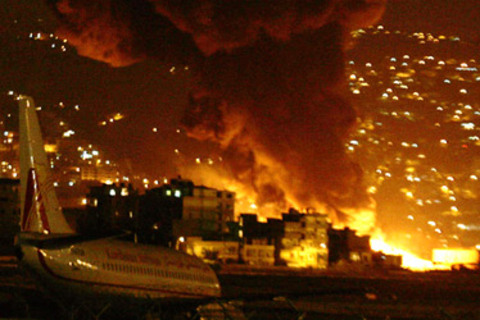
“Birth pangs” of Condi Rice’s “new Middle East” (Beirut airport: 2006)

beirut airport in flames 2006 war

The real birth pangs of a new Middle East (Tahrir Square today):

egyptian protesters
And Israel trembles.

Here, one of Bibi’s typically anonymous cabinet ministers not only speaks condescendingly to Arabs fighting for their freedom, but virtually quotes one of Richard Perle’s more noxious and absurd bon mots, that democracies never start wars:

“We believe that Egypt is going to overcome the current wave of demonstrations, but we have to look to the future,” says the minister in the government of Prime Minister Benjamin Netanyahu…While it may be more efficient to deal with a strongman in Cairo…and a King in Amman, democracies make better neighbors, “because democracies do not initiate wars,” he says.

“Having said that, I’m not sure the time is right for the Arab region to go through the democratic process,” he adds.

The minister…cites the Gaza Strip as a signal warning of the risk that comes with asking the people what they want. The seaside territory…elected the militant Islamist group Hamas in a 2006 election that had been carried out at the urging of George W. Bush, when the President was casting the invasion of Iraq as a mission to introduce democracy to the Middle East.

All well and good in the long run, according to the official, but Arab societies demand “a longer-term democratization process,” one accompanied by education reforms that would encourage the election of moderates. “You can’t make it with elections, especially in the current situation where radical elements, especially Islamist groups, may exploit the situation,” he says. “It might take a generation or so.”

That sounds like the Likudist view of the entire Israeli-Arab peace process, one explicitly advanced by Avigdor Lieberman among others.  I’ve got something to tell this guy: democracy, or whatever’s happening in Egypt ain’t gonna wait a generation or even a year.  It’s comin’ and comin’ fast.  And it ain’t gonna slow down for anyone least of all a Likud cabinet minister.

Israel, I’m sorry to say, appears almost as much a dinosaur as the strong men who are falling like, well dinosaurs. It is as tone-deaf, as entrenched, as in favor of a failed status quo, and as incapable of reform as any Egyptian or Tunisian tinpot dictator.  For example, this is the headline in a Haaretz story: Israel urges world to curb criticism of Egypt’s Mubarak. What is it about Egypt that Bibi just doesn’t get? Mubarak is finished. The old order is finished. It may be possible for Israel to achieve a satisfactory modus vivendi with whoever takes power, but this nonsense simply won’t due unless Bibi wants to goad Egyptians into hating Israel more than even do now.

There is a bit of unintentional acuity in the statement of an official likely connected to Lieberman’s foreign ministry:

Jordan and Saudi Arabia see the reactions in the West, how everyone is abandoning Mubarak, and this will have very serious implications.”

And isn’t that all to the better? Let kings and potentates tremble. Let them consider their fates and act accordingly. Let them consider whether a failed, cold peace is satisfactory to their people. Or whether the region demands something more and better from the State of Israel.

Amnesty International Condemns Makhoul Sentence

Monday, January 31st, 2011

An Amnesty press release:

Amnesty International Calls Jailing of Human Rights Defender in Israel “Very Disturbing”

(London) — Amnesty International urged the Israeli authorities to end their harassment of Palestinian human rights activists after a veteran Palestinian campaigner was jailed for nine years earlier today and given an additional one-year suspended sentence.

Ameer Makhoul, a longstanding Palestinian activist, was convicted on various counts of having contact with enemies of Israel and espionage after a plea bargain agreement at his trial. He was originally charged with an even more serious offense, “assisting an enemy in war”, which could have carried a life sentence, but that was dropped by the prosecution when he agreed to a plea bargain.

“Ameer Makhoul’s jailing is a very disturbing development and we will be studying the details of the sentencing as soon as we can,” said Philip Luther, Amnesty International’s Middle East and North Africa deputy director.

“Ameer Makhoul is well known for his human rights activism on behalf of Palestinians in Israel and those living under Israeli occupation. We fear that this may be the underlying reason for his imprisonment.”

“We are also extremely concerned by allegations that he was tortured and otherwise ill-treated following his arrest on May 6 last year in a dawn police raid on his home in Haifa, by the fact that he was not permitted to see his lawyers for 12 days after his arrest, and by the gag order that prohibited media coverage on the case during this time.”

In the United States, Amnesty International USA urged President Obama to call on Israel to end the harassment of human rights defenders.

Under the Israeli penal code, people can be charged with “espionage” even if the information passed onto an “enemy agent” is publicly known and even if there is no intent to do harm through passing on the information.

The prosecution claimed that a Jordanian civil society activist who Makhoul was in contact with was a Hizbullah agent, and that he gave this person information on the locations of a military base and General Security Services offices.

The confession on which Makhoul’s conviction and sentencing were based was admitted as evidence by the court, despite allegations that this statement was made under duress and that he was tortured during his interrogation. It also appears that the information allegedly conveyed by Makhoul was publicly available.

Makhoul’s sentencing comes at a time when human rights activists are coming under increasing pressure in Israel and being accused by some in the government and by members of the Knesset of being “anti-Israel” and unpatriotic because of their reporting on and campaigning against human rights violations in Israel and the Occupied Palestinian Territories.

Makhoul is the director of Ittijah, the Union of Arab Community-Based Associations, based in Haifa.

Addameer, the Palestinian prisoner support group based in Ramallah called for the PA, EU and other western representatives to demand Makhoul’s release and to raise the prisoner-victim’s plight with Israeli officials at every meeting they hold.

Makhoul Sentenced to 9 Years, Israeli Democracy Dies Yet Another Death

Sunday, January 30th, 2011
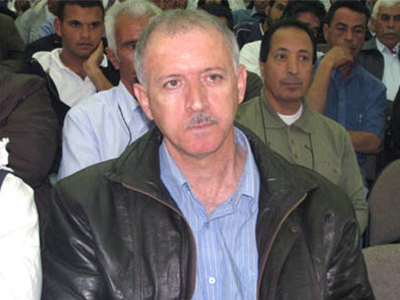
makhoul in court

Ameer Makhoul in an Israeli court

Ameer Makhoul, Israeli-Palestinian community leader, was sentenced by an Israeli court to nine years in prison for allegedly spying for Hezbollah against Israel.  The court also added an additional year to his sentence on conditional terms.  This was essentially the sentence the prosecution had requested, with the defense asking for seven years.  The court, as it almost always is in security cases, proved to be rubber stamp for the State.

Makhoul has two teen-age daughters a third of whose lives he will have missed by the time he is freed.  That’s IF he is freed as the State has a habit of extending sentences for prisoners for whom it has special distaste (cf. the recent case of Abdallah Abu Rahme).

They say in a democracy a man is innocent till proven guilty.  Well, Makhoul is innocent and wasn’t proven guilty, but he’s still going to prison.  So what does that say about Israel’s form of democracy?  A democracy perhaps for Jews (unless you’re really uppity like Jonathan Pollak or the Shministim), but for Palestinian citizens?  Not so much.

Makhoul is guilty of nothing more than having contacts outside Israel with other Arab peace and environmental activists (NOT Hezbollah agents as claimed).  He was the director of a community NGO doing his job as such people do in every democracy in the world without having their lives stolen from them for it.

In fact, what is so laughable about the charges is that the alleged spying happened in Jordan, a state with which Israel has generally cordial relations.  The notion that Hezbollah would engage in spying on Jordanian soil or that Jordanian intelligence would allow such activity is preposterous.

And just listen to the chief judge reciting the litany of Makhoul’s “crimes” and ask yourself whether a Palestinian either would have acess to any of this information of would care even if he could:

[Hezbollah] requested that he pass on to them intelligence about the residence of the Shabak chief and arrangements of the security detail at his home, along with the travel arrangements of the security details of the prime minister and defense minister.

Let me parse this for you: the Shabak and Mossad have killed Palestinians, Syrians, Lebanese, you name it, in the name of promoting Israeli security.  Hezbollah has vowed revenge for these killings (al-Mabouh, Mugniyeh most notably) and has expressly pointed to Israeli leaders as targets.  Shabak has no evidence that any Israeli Palestinian has become party to such a plot of vengeance.  But it needs to stir the pot of fear and paranoia among Israeli Jews that this COULD happen.  So it picks the most ornery, uppity Palestinian leader it can find and chooses to make an example of him.  With this it kills two birds with one stone.  It justifies its existence to the Israeli Jewish public AND it suppresses the political aspirations of Israeli Palestinians.

Whatever “evidence” was amassed by secret police or offered at trial will never be known.  This is the Israeli police state at its worst.  This is Israeli “justice.”

My readers who support the Israeli government’s draconian treatment of its Palestinian citizens will point to Makhoul’s “admission” of guilt as proof that Shabak proved its case.  Not at all.  As the victim’s attorney noted, he knew of not a single case in which a Palestinian security defendant went to trial and was acquited.  Never.  Not once.  Shabak gets its man, every time.  So Makhoul was faced with a choice of ten years or a possible life sentence if (or I should say “when”) found guilty.  So yes, discretion was the better part of valor.

I want to put those who cheer for this strange justice in Makhoul’s shoes.  If you had two daughters you loved dearly, were innocent, and knew you had virtually no chance of beating a rap, would you risk an almost certain life sentence in a vain attempt to stand up for the principle of your innocence?

Ameer Makhoul walks into an Israeli prison cell an innocent man.  Instead, J’Accuse.  I accuse Shabak of being guilty.  Guilty of destroying Israeli democracy.  Guilty of poisoning relations between Israel Jews and Palestinians.  Guilty, guilty, guilty.  Maybe some day Yuval Diskin will serve time himself for the travesties he and his agents have perpetrated in the name of security for Israel’s Jews and the country’s few “good Arabs.”

All around Israel the flames of fading autocratic regimes are raging.  Regimes whose rule was supported by the type of heavy-handed torture and running rough-shod over individual rights as exemplified by Shabak.  Will it take long before justice comes even to the gates of Jerusalem and Shabak’s prisons?

Israeli Deputy Prime Minister: Arab Democracy Threatens Israel

Sunday, January 30th, 2011
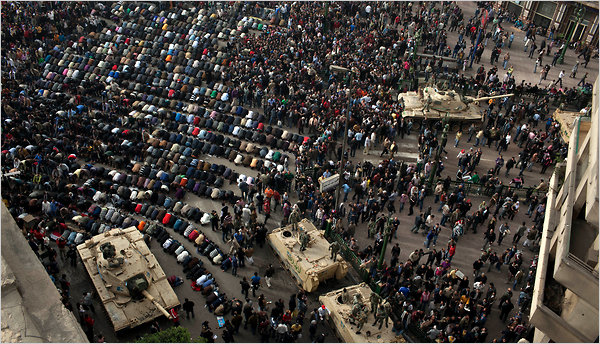
egyptian demonstrations

Egyptians pray in front of army tanks in Tahrir Square (Scott Nelson/NYT)

Deputy Israeli prime minister Silvan Shalom made a telling comment in an Israel Radio interview that was captured in Al Ahram (Google cached version) during the Tunisian revolution:

“I fear that we now stand before a new and very critical phase in the Arab world. If the current Tunisian regime collapses, it will not affect Israel’s present national security in a significant way,” he said. “But we can, however, assume that these developments would set a precedent that could be repeated in other countries, possibly affecting directly the stability of our system.”

Shalom added that if regimes neighbouring the Israeli state were replaced by democratic systems, Israeli national security might significantly be threatened. The new systems would defend or adopt agendas that are inherently opposed to Israeli national security, he said.

The deputy indicated that Israel and most of the Arab regimes have a common interest in fighting what he referred to as “Islamic fundamentalism” and its “radical” organisations which threaten Israel.

This threat, he added, is the reason behind much of the direct and indirect intelligence and security coördination between Israel and the Arab regimes.

Shalom emphasised that a democratic Arab world would end this present allegiance, because a democratic system would be governed by a public generally opposed to Israel.

You can gussy this view up in many ways that explain Israel’s concerns, but when it comes down to it Israel fears the Arab street and Arab democracy.  Yes, it’s true that Arab democracies would hold harsher views concerning Israel than the current autocrat rulers.  Though this isn’t necessarily so in the case of a Muslim democracy like Turkey which, until its citizens were murdered en masse in the Flotilla, actually had constructive relations with Israel.

All that aside, the issue goes beyond what Shalom said, as I wrote last night.  Arab democracy threatens Israel especially because it is outside Israel’s control.  It cannot be bought and dominated militarily or diplomatically.  A democracy represents the interests of the majority and not those of the élite.  Israel needs lackeys and strong men.  It needs the go-to guy it can do deals with.  Having to negotiate its way through the cross-currents and multiple sets of interests at work in the typical democracy has to be bewildering, even frightening to Israel’s leaders.  If Mubarak goes then there are big changes in store…for Egypt and Israel.

The Nation is reporting that Mubarak’s son, long considered the heir to the Egyptian throne, er presidency, has fled the country for London, along with the ruler’s daughters and even his wife.  Given the dynasticism of Arab regimes and family closeness and solidarity in Arab culture, an eldest son’s desertion of his father has to be big blow to Hosni Mubarak.  This too is a development every Egyptian will take note of.  This could be the beginning of the end for Mubarak.  But the question is who and what will take his place.  Will it be a loyalist like Suleiman who will be a slightly different face pinned on the same body?  Or will Suleiman be content to be a caretaker for new, truly free elections and a new government?

What role will the Muslim Brotherhood play?  Is there a possible path that integrates an Islamist vision with a democratic one? In a country that has suffered decades, if not longer, of unalloyed despotism?

Finally, Israel will have to get used to living in a region that is even less hospitable to its policies than it was before.  It will have to negotiate a dense thicket of national interests none of which will be obsequious toward it.  Welcome to a brave new world, Mr. Netanyahu.  Good luck.

One thing especially frightening to Israel is the potential Islamist nature of the incoming governments.  For Israel, Islamism is a synonym for terror.  Most reasonable observers know this isn’t true.  Another thing Israel fears is that it may become as much an obstacle to regional development as the octogenarian strongmen whose rule is being toppled in Tunisia and Egypt.  Israel has identified itself so closely with the oligarchs that the new rulers, whoever they may be, may (probably will) see Israel as an extension of them.  That’s why I’ve argued that a course correction in Israeli policy has been long overdue.

It’s worth quoting Gideon Levy, as usual eloquent on the subject of Middle Eastern tyranny:

The people of Egypt had their say, and had the nerve not to fall in line with Israeli wishes. A moment before Mubarak’s fate is sealed, the time has come for drawing the Israeli conclusions.

Not a plague of darkness in Egypt but the light of the Nile: the end of a regime propped up by bayonets is foretold. It can go on for years, and the downfall sometimes comes at the least expected time, but in the end it will happen. Not only Damascus and Amman, Tripoli and Rabat, Tehran and Pyongyang: Ramallah and Gaza are also destined to be shaken.

The hypocritical and sanctimonious division of countries by the U.S. and the West between the “axis of evil” on the one hand, and the “moderates” on the other, has collapsed. If there is an axis of evil, then it includes all the non-democratic regimes, including the “moderates” and the “stable” and the “pro-Western.” Today Egypt, tomorrow Palestine. Yesterday Tunis, tomorrow Gaza.

Not only is the Fatah regime in Ramallah and the Hamas regime in Gaza destined to fall, but perhaps also, one day, the Israeli occupation, which certainly meets all the criteria of criminal tyranny and an evil regime. It too relies only on guns. It too is hated by all levels of the ruled people, even if they stand helpless, unorganized and unequipped, facing a big army. The first conclusion: Better to end it well, with agreements based on justice and not on power, a moment before the masses have their say and succeed in banishing the darkness.

A second, no less important conclusion: Alliances with unpopular regimes can be torn up overnight. As long as the masses in Egypt and in the entire Arab world continue seeing the images of tyranny and violence from the occupied territories, Israel will not be able to be accepted, even it is acceptable to a few regimes.

The Egyptian regime became an ally of the Israeli occupation. The joint siege of Gaza is irrefutable proof of that. The Egyptian people didn’t like it. They never liked the peace agreement with Israel, in which Israel committed itself to “respect the legitimate rights of the Palestinian people” but never kept its word. Instead, the people of Egypt got the scenes of Operation Cast Lead.

It is not enough to have a handful of embassies in order to be accepted in the region. There also have to be embassies of goodwill, a just image and a state that is not an occupier. Israel has to make its way into the hearts of the Arab peoples, who will never agree to the continued repression of their brothers, even if their intelligence ministers will continue to cooperate with Israel.

A real alliance with Egypt and its sister-states can only be based on the end of the occupation, as desired by the Egyptian people, and not on a common enemy, as an interest of its regime.

A comparison between the impact of Islamism and Jewish extremism is also warranted.  Israel itself has done the same as what these new potentially Islamist-oriented regimes may.  It has focussed on the sectarian Jewish nature of its state to the exclusion of its non-Jewish citizens.  It has fueled the cries of racism from its Palestinian citizens and Jewish peace activists alike.  For many Muslims, unfortunately, Judaism has become synonymous with terror, as they see Israelis like Meir Dagan kill Muslims while invoking the name of the “Jewish people.”  Can Israel truly blame the Muslims of the Middle East for doing what the “Jewish State” itself has done?  What we truly need in the Middle East is democracy that focuses on the political interests of each nation to the exclusion of religious sectarianism.  Mixing religion and politics is deeply toxic whether it happens in Israel or Iran.

Teheran 2009: Precursor of Middle Eastern Revolutions

Saturday, January 29th, 2011

In all the coverage I’ve read of the Tunisian and impending Egyptian political revolutions I haven’t read any observer make the connection that came to me today.  If there is any precursor to these earth-shaking acts of social transformation, it might be in the June, 2009 convulsions that rocked Iran following the contested elections there.  While it’s true that the Iranian mullahs outlasted and outmuscled their opponents and preserved their hold on power, I think the drama of this near-revolution wasn’t lost on young people throughout the region struggling under the burden of similarly corrupt, unresponsive and autocratic regimes.  While Iran was a near miss, I think it may’ve inspired others.

Other similarities come to mind: Iran’s Green Revolution was powered largely by disaffected, non-ideological youth fed up with a moribund system that offered them no prospects either economically or politically.  The vision of the reformers was an Iranian democratic system that retained its Muslim character.  Tunisia, a much more secular country, certainly lacked the impulse for a Muslim component to its revolution.  But the cries for democracy and an end to rule by fiat would certainly resonate in both Iran 2010 and Tunisia 2011. Each of these revolutions had its martyr: Mohamed Bouazizi is Tunisia’s Neda Soltan.

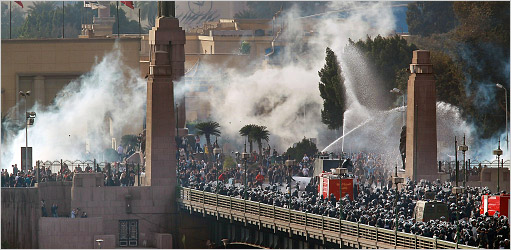
cairo demonstrations

Egyptian protesters fight for key bridge (Peter Macdiarmid/Getty)

Cairo’s revolution is still in the making and no one can tell what will happen there.  Mubarak has been sly and skilled in dividing and conquering his political competitors and enemies.  No one knows whether he can pull this one out or will be buried by the weight of the nation’s disillusionment with him.  The stakes are very high.  Egypt is one of the most populous nations in the region with one of the largest militaries.  It also has a rocky historical relationship with Israel along with a potent Islamist movement that could possibly either come to power or play a critical role in a post-Mubarak era.  While it appears impossible that Egypt could be the author of a second Islamist revolution à la Iran, it still wouldn’t take much to drastically alter the playing field of Middle Eastern politics.

If Mubarak goes, one of America’s strongest allies in the region will disappear.  While Israel’s relationship ran more cold than hot, at least it knew what to expect of Egypt under Mubarak.  A radical change at the top will make both Israel and America terribly nervous.  Imagine for example, an Egypt which was not hostile to Hamas. I’m not even talking about a new government that would embrace or endorse Hamas, but one that would merely be neutral. You can see right there how this would severely undermine the current consensus that Hamas is the devil incarnate.

Despite the U.S. calls for democracy in the region (especially under George Bush), the truth is that America prefers the devil it knows to the one it doesn’t.  And make no mistake, true democracy in the Middle East is a scary proposition for both.  What George Bush and other American leaders never understood is that democracy means independence: independent thinking, independent alliances, nations seeking their own interests rather than the interest of a ruling élite.  That is not something that makes us uncomfortable.  We (and I include Israel in this) want countries subservient to us and our interests.  Sure, we’re willing to collude with the Mubaraks and Ben Alis and give them what they want.  But we want something in return.

Truly democratic regimes will be seeking not the interests of a ruling family, but of an entire nation.  And this may, indeed will bring these countries into conflict with their former allies, mentors and masters.  It could be a long, rocky road.

Returning to Iran: the results of these upheavals won’t be lost either on the regime or the reformers.  While the ruling Ayatollahs mustered more flexibility and political shrewdness in holding off their adversaries, there could be a fire next time to quote James Baldwin.  Next time the mullahs may neither be as lucky or as successful.  The example of one and perhaps two (and if Yemen’s dictator goes, perhaps three) tyrants being felled in a short interval will resonate throughout Iran.  The fact that these revolutions are powered largely by a vision of democracy (or if not that, then at least greater freedom) and not specifically by Islam does not bode well for Iran’s rulers either.

If there is massive change in regimes, it will not bode well for Israel.  As the Palestine Papers have revealed, Israel thrives on forcing its will on its Arab opponents.  When there is a new set of leaders who cannot be co-opted, coerced or colluded with, all bets are off.  Israel must feel like the Chinese proverb: may you be cursed to live in interesting times.

One thing we learned from the Teheran upheaval is that everything can change or perhaps nothing.  So we’ll have to see how things develop.

Israel Decries Militant Arms Caches in Schools, Mosques: Pot Calls Kettle…

Thursday, January 27th, 2011
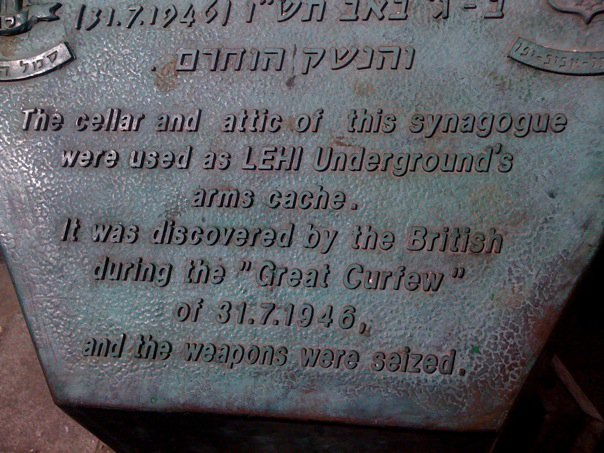
lehi hid arms cache in synagogue

Lehi too used synagogues to hide its weapons

You know the drill: Hamas and Hezbollah commit the cowardly and unpardonable sin of hiding weapons caches in sites like schools, hospitals, mosques, ambulances.  This not only justifies attacking sacred sites and any collateral damage to civilians (cf. if only they fought fair), it also serves to reinforce the brutal image of the enemy in the average Israeli’s mind.

I’ve already drilled this notion full of wholes by displaying an Israeli plaque commemorating a Yishuv-era arms cache hidden in a synagogue.  Of course, this means there had to be scores of other similar troves in similar locations in the pre-and post-state era.  Now, Yossi Melman has profiled a doctoral dissertation by a retired military officer which deals solely with this subject:

The…caches were used mainly to hide weapons and ammunition (but also communication gear and archives ) of the fighting organizations from 1918 to 1948…He found that toward the end of the British Mandate in Palestine, there were more 1,500 weapons caches here, in kibbutzim, moshavim, cities and towns. The book demonstrates the wide variety of caches, which were constructed with a great deal of ingenuity, both above and below ground, and even at the bottom of reservoirs.

What I find curious about Melman’s article in the English version is that it completely omits identifying where the caches were located.  A check of the Hebrew indicates quite a selective, even dubious  translation job which entirely omitted this important passage from the English version:

Members of the pre-State fighting organizations didn’t hesitate to use for this purpose childrens’ nurseries in kibbutzim and synagogues.

There were, for example, two caches in the Old City’s Hurva synagogue [ed., which may explain why the Jordanians destroyed the building after they conquered East Jerusalem], one for Lehi and one for Etzel.  The Haganah also had caches in synagogues in many moshavim.  Similar use of ambulances also was made.  At the height of the 1929 riots, Manya Shohat, one of the founders of HaShomer [early Yishuv paramilitary defense group], moved a trove of weapons from Kfar Giladi to Haifa in a bus disguised as an ambulance.  She wore a nurse’s uniform and another family member became the sick person.

The thinking behind such tactics was that the British soldiers and officers were gentlemen and wouldn’t dare search such locations.

Perhaps the passage was omitted because it makes this finger-wagging by Melman look like a hollow exercise:

This out-of-bounds and cynical use of such places is widely condemned by human rights organizations and governments. Israel depicts such misuse as violating international law, the rules of warfare and every accepted moral norm, so Israeli security forces are able to justify striking mosques and exercising a heavy hand at checkpoints – to the point of preventing the movement of sick Palestinians in ambulances.

Israel’s claims and condemnations are justified. Even terror organizations should obey the basic rules of right and wrong.

What’s good for the goose…

‘Iranium’ Heritage Foundation Premiere, Iranian Star of Film: ‘If U.S. Won’t Bomb Iran, Israel Should’

Thursday, January 27th, 2011


Now, the moment so many of you have all been waiting for: the première of Clarion Fund/Aish Hatorah’s latest magnum opus in its epic trilogy of Islamophobia.  Iranium is coming.  It will be premiered (where else) at the Heritage Foundation and introduced by one of the great neocon charlatans, Richard Perle.  It will be screened at New York City AMC Theaters.  Years in the making and with a cast of neocon thousands (well, OK maybe “tens”) and a seeminly unlimited budget (fronted no doubt by far-right Jewish Republican fatcats like Barre Seid who spent $17-million promoting Obsession), Iranium will scare the wits out of you (well, maybe not you) and send you crawling to your local Congress member demanding that they do something, anything about Iran before it’s too late.

Ali Gharib and Eli Clifton actually watched the entire film before Clarion locked down its Vimeo account and made the file private.  Their review is available at Teheran Bureau.  If anyone here has access to the full length version, please let me know.  I think it’s critical that progressives watch this film, blog about it and so steal the thunder from Clarion and the war party advocating attacking Iran.  The more we can tell the world what this film is really about the less people will fall prey to the inevitable propaganda that will pass for objective information about the “Iranian threat.”

reza khalili

Reza Khalili: alleged Iranian double agent and star of 'Iranium' (Reuters)

I’ve been watching video segments consisting of portions of the film and one sticks out like a sore thumb.  It’s video of an interview with an alleged Iranian CIA spy, Reza Khalili (not his real name, nor is anything else about this guy genuine).  The name was familiar to me and then I realized why.  Yossi Melman profiled him in Haaretz.  When I read his piece something about it smelled fishy.  This was confirmed when Prof. Muhammad Sahimi also suspected fraud.  He wrote about the alleged spy:

Even according to him [Khalili], the last time he was with the IRGC [Revolutionary Guards] – if he was – was in late 1980s, twenty-years ago. Things have changed fundamentally. The IRGC has changed, but so also has the society. What relevance his “experience” has to the current state of affairs? None.

The article is also full of inaccuracies…When he was supposedly with the IRGC, there was no nuclear program to speak of; so what does he know? As much as anyone else based on public information.

…This guy, Khalili is not even smart. If he were, he would try to make his case without invoking Israel and the Nazis.  The very fact that he does goes to show that he is associated with lunatics and at best is an opportunist.

On this subject, can you tell me any Iranian besides the Mujahadeen e-Khalq, who publicly advocate bombing Iran and who say if the U.S. doesn’t have the nerve they hope Israel will? Can you tell me any Iranian (other than perhaps monarchists living in Beverly Hills) who ape Bibi’s “it’s 1938 and Teheran is Munich” hysteria? Can you tell me any Iranian who complains that the West had a chance to overthrow the Iranian regime last June “without firing a single bullet” and didn’t do it? Do you know an Iranian who believes that among the last remaining signs of the coming of the Iranian messiah that must occur are the “destruction of Israel and bombing of Persian oil fields and European capitals?”

Does this guy pass the smell test?

One of the few honest statements in Melman’s profile is an acknowledgement that Khalili is associated with “conservative right-wing circles in the U.S.” Among other lies or misstatements in Melman’s profile is the claim that Khalili’s alleged mentor Dr. Ali Shariati, was assassinated by the SAVAK (Iran’s Shah-era secret police). Prof. Sahimi correctly notes that Shariati died of a terminal illness and was not killed by anyone. Either Khalili is making up stories and Melman hasn’t done his research or Melman himself is trying to pass off lies as truth.

Melman’s story also claims that Khalili taught Revolutionary Guard personnel how to use computers. In another passage, Khalili notes that his most active period in the Guard was in the “early 1980s.” I myself took a computer science course at Columbia University in 1980 and computers were in their infancy. Microsoft didn’t even begin as a company until 1980 and Windows wasn’t developed until 1985. I am dubious that Khalili taught anyone anywhere computers in the early 1980s.  Another strike against him.

Clarion Fund has also trotted out similar alleged Muslim “turncoats” to people its earlier films, among them the notorious Zuhdi Jasser, the star of Third Jihad.  Before that it was Walid Shoebat, the fake PLO terrorist, and Tawfiq Hamid.  So it’s a common ploy of these people to latch onto sources of dubious repute and hang the weight of their expose on the expertise they bring and the ‘authenticity’ of their inside knowledge of the subject, whether it be the race for the world Muslim Caliphate or Iranian world ‘domination.

Take a look at a few of Khalili’s bedfellows and you’ll get a sense of how trustworthy he is.  Roger Simon of Pajamas Media interviewed him in 2008, claiming the CIA offered an email approving publication of a profile of him (thus giving him the CIA Good Housekeeping seal of approval).  Pat Robertson’s CBN also featured him.

Khalili has even written an “exposé” of his “double-life” working for the CIA while a Revolutionary Guard, A Time to Betray.  It even looks like he hoodwinked as formidable a journalistic figure as the Washington Post’s David Ignatius into reviewing it (and highly favorably I might add).

I invite my readers to peruse other video footage used in Iranium. If you note any similar howlers to this one please let me know. We’ve got to take this propaganda apart line by line if necessary to drain the toxin from the body politic that the film is liable to build up.