Mahzor

New York Public Library

Churches

Sarajevo Haggadah

Mah Nishtanah

Sarajevo haggadah

Antaea Darom

Israeli women's art

Action

Torah as music

Ben Heine

Action

ceramic bowl

Mohammad Said Kalash, "Offering Reconciliation" exhibit (photo: Ilan Amihai)

Action

Punch and Judy/Pinchas and Jamila

Avi Katz

Action

David Grossman

Ben Heine

Action

Eldrige Street shul

Lower East Side

Action

Dove

Ben Heine

Action

Two birds

Hoda Jamal

Action

Israeli and Palestinian boys

from documentary, Promises

Action

Cat in the Hat

Yiddish version

Action

Daylight through the Wall

Banksy: graffiti art on Separation Wall

Action

Maurice Sendak's Brundibar set

New Victory Theater (photo: Nan Melville/NYT)

Action

Daniel Barenboim, West-Eastern Divan Orchestra

Palestinian-Israeli musical ensemble (photo: Kerstin Joensson/AP)

Action

Great Day on Eldrige Street

N.Y.'s klezmer greats celebrate shul rededication (photo: Leo Sorel)

Action

Joint Appeal for Peace

(Avi Katz)

Joint Appeal for Peace

Ketubah, Ancona, Italy (1772)

(Jewish Theological Seminary library)

Ancona ketubah

Posts Tagged ‘iraq-war’

Dick Cheney and Herbert Hoover, One Thing in Common

Saturday, January 27th, 2007

From today’s Maureen Dowd column, Daffy Does Doom (TimesSelect required):

Delusional is far too mild a word to describe Dick Cheney. Delusional doesn’t begin to capture the profound, transcendental one-flew-over daftness of the man.

Has anyone in the history of the United States ever been so singularly wrong and misguided about such phenomenally important events and continued to insist he’s right in the face of overwhelming evidence to the contrary?

Yes, Herbert Hoover. But the difference is that Herbert Hoover was a moderate Republican who actually cared about the people whom the Depression dispossessed. He just didn’t have a clue what to do about it. Cheney doesn’t even have that (being moderate or caring about the victims of his policies) in his favor. But he does share with Hoover the fact that he has no clue about how to deal with his ‘Great Depression,’ Iraq.

And I also ‘enjoyed’ this quotation from a Cheney interview with Wolf Blitzer about U.S. ‘successes’ in Iraq:

“Bottom line,” Vice told Wolf, “is that we’ve had enormous successes, and we will continue to have enormous successes.”

You bet. If you label 3,000+ American-and hundreds of thousands of Iraqi deaths as “enormous successes.”

Tyrant Saddam is Dead, Long Live the Next Tyrant

Friday, December 29th, 2006

As the British used to say: “The King is dead, long live the King.”

Yes, they’ve killed Saddam, a figure who faded curiously fast both from history and from any relevance to the maelstrom that currently is Iraq. And doubtless Tony Snow will sally forth with some chortling statement about how the U.S. has made one step for freedom, one small step for human kind. But it will be irrelevant, just as Saddam himself became irrelevant almost from the moment he was toppled. It is both curious and tragic that just as the former tyrant has faded from the stage of history, so the U.S. has faded as a decisive player in Iraq. We no longer matter there. If our troops are there insurgents would just as soon kill them. But when our troops are gone they will move on and kill some other perceived ethnic or religious enemy. They are now just thugs with a grievance and the means to express it through acts of torture and murder. We are mere foils or props for their rage.

And we should make no mistake. Saddam’s death by now is a mere irrelevancy. What is far more telling and important is the tyrants in waiting in their hundreds, thousands, and tens of thousands whom we are creating with our hateful policies throughout the world, but especially in the Mideast.

frances fragos townsendWarming the cockles of Orwell’s heart

And while we’re talking about bad guys, thanks to Jason Truesdell for pointing me to this terrific find from TPMuckraker. CNN interviewed Homeland Security Advisor Frances Fragos Townsend. Its White House correspondent, Ed Henry, posed to her the eternal nagging Osama question:

HENRY: You know, going back to September 2001, the president said, dead or alive, we’re going to get him. Still don’t have him. I know you are saying there’s successes on the war on terror, and there have been. That’s a failure.

That matter has been raised a million times or more and always answered in the same dull, unresponsive way. But Townsend, to her questionable credit, put a whole new spin on it with her highly “creative” answer:

TOWNSEND: Well, I’m not sure — it’s a success that hasn’t occurred yet. I don’t know that I view that as a failure.

Yes indeed. We may not have gotten Osama yet. But that’s no failure. It’s merely a success waiting to happen. That’s deep, mighty deep. I think even old Kant would have trouble parsing that one. Or as Jason wrote me: “I thought Orwell was supposed to be a warning, not a source of inspiration.”

For some odd reason, it brought to mind an old Jewish joke about a Jew who reads in the paper about the huge lottery jackpot. He begins thinking about all the wonderful good deeds he can perform for his synagogue and the community with his winnings. But each week he looks for the winner’s name and it isn’t his. Finally, in frustration he cries out to God: “Lord, I only wanted this for You. Why have you denied me?” A startled and put-out God replies: “Itzik, buy a ticket.”

The problem with the Bushites is that they refuse to buy a ticket or even play by the rules. Rather, they make up the rules and expect reality will conform with them. To their chagrin, reality has stopped conforming to their expectations making for very messy times.

Bush Tepid While Israel Rejects Iraq Study Group Proposals

Thursday, December 7th, 2006

Ehud Olmert, banking on the Cheney Nyetniks outlasting Jim Baker and the rest of the Iraq Study Group, has rejected the causal connection drawn by the ISG report between Mideast instability and the ongoing Israeli-Arab conflict. It is a truth almost universally accepted (except among neocon and nationalist Israeli circles) that the continuing bloodshed between Israelis and Palestinians deeply exacerbates Arab hostility toward the U.S., which is seen as the guarantor of Israeli security. But not so Mr. Olmert:

“The Middle East has a lot of problems that are not connected to us,” Mr. Olmert said at a press conference in Tel Aviv. “I am not convinced that this report foists all of the U.S.’s troubles on Israel’s shoulders.”

Olmert is, of course, disingenuous in that last comment since the Report does not “foist all of the U.S.’ troubles on Israel,” but it sure does foist some of our problems rightfully on Israel’s intransigent positions vis a vis its neighbors.

President Bush’s muted reaction to the Report today indicates that, just as with the 9/11 Commission report, he’d like to bury it as soon as a decent interval has elapsed. He has done everything to renounce it but saying so in explicit words:

He called the report “very constructive” and “worthy of study,” but said that neither Congress nor the administration would accept all of the panel’s proposals. His policy going forward, Mr. Bush reiterated, would rely not just on the study group’s recommendations but on those being formulated by the Pentagon, the State Department and the National Security Council.

True to form, he’s attempting to bury the findings amid conflicting policy directives from multiple agencies that would be likely to contradict the ISG report. Sounds like the WMD fiasco all over again. You don’t have to disprove your opponent. You merely have to bury unwelcome political statements or developments in a blizzard of conflicting opinion.

The hopelessness and futility of the ISG’s efforts to turn around the ship of state on this issue can be seen in this exchange between Bush and a reporter at the Bush-Blair news conference:

When a British reporter asked him whether his choice of words showed that he was “still in denial about how bad things are in Iraq,” Mr. Bush made his feelings clear.

“Make no mistake about it, I understand how tough it is, sir. I talk to the families” of those who have died. “I also believe we’re going to succeed. I believe we’ll prevail,” he said.

“One way to assure failure is just to quit, is not to adjust, and say it’s just not worth it,” he added. “If we were to fail, that failed policy will come to hurt generations of Americans in the future.”

Actually, Bush is right. “One way,” (the only way actually) “to assure failure IS not to adjust” your policy. To continue down the garden path of denial and obstinacy which has somehow gotten you this far. “Neck deep in the Big Muddy and the big fool says to push on,” to quote Pete Seeger’s prescient lyrics.

And for anyone who doubted that the U.S. is dictating Israeli policy toward Syria, check out this telling admission from Olmert:

“The opinions I heard from the president and from all senior administration staff on the Syrian issue are such that he did not see a feasibility in talks on the American-Syrian track or on the Israeli-Syrian track,” Mr. Olmert said.

The Bush administration says Syria is aiding the insurgency in Iraq, while Israel says Syria assists Hezbollah, Hamas and Islamic Jihad, all radical Islamic groups in conflict with Israel.

The Syrian actions do not “create a picture of the possibility for talks in the near future,” Mr. Olmert said.

Of course, if Israel truly saw it in its interest to talk to Syria it would without hesitation as the former has often pursued policies inimical to previous U.S. administrations. In this case, perhaps, the agendas of both countries are aligned (or I should say “misaligned” since the rejection of Syrian engagement is deeply misguided as the ISG notes).

Bush himself confirmed the unrealistic nature of his expectations regarding Iran and Syria with this statement:

“If people come to the table to discuss Iraq they need to come understanding their responsibilities to not fund terrorists, to help this young democracy survive, to help with the economics of the country.

“And if people are not committed,” the president added, “if Syria and Iran is not committed to that concept, then they shouldn’t bother to show up.”

Israel and the U.S. have the same exact approach to diplomatic negotiations. Place conditions on the behavior of your enemy which they must meet BEFORE you will even agree to meet them. It doesn’t matter that in the past you have often negotiated with enemies without such preconditions (North Vietnam comes to mind). If you really want to destroy the chance for engagement, you ignore past history and focus on creating circumstances that will foil an undesirable outcome, in this case talks with Iran and Syria.

Jim Baker and Lee Hamilton are no fools. They know that Bush has dumped them. That’s why they’re appealing to Congress for “very vigorous oversight of the war effort” (Hamilton). It’s really up to Congress, I’m sorry to say. Sorry for two reasons: one because it means that Bush is an entirely hopeless proposition, an irrelevancy from here on to the end of his term; and second, because I have profound doubts about whether Congress is up to the task of providing such vigorous oversight. Pelosi and Reid, prove me wrong, please.

U.S. Former-Ambassador to Syria, Israel Calls for Ending Syrian Freeze

Wednesday, November 1st, 2006
james baker and edward djerejianJames Baker and Edward Djerejian (credit: Rice University)

Edward Djerejian, director of the Baker Institute for Public Policy, and one of James Baker’s most trusted aides, wrote an eye-opening article in Foreign Affairs Magazine, urging a new U.S. policy toward Syria. Normally, such an article would be worthy of a read, but not much more. But in this case, what Djerejian says has added import because young Bush has assigned his father’s consigliere to get him out of the Mideast quagmire in which he’s foundering. Just how serious a project is the Iraq Study Group created by Baker? Will Junior listen if it’s directives counter his own notions? The jury is still out. But one thing is for sure–if George Bush takes what Baker offers seriously, then what Djerejian writes has extreme significance in terms of engineering a possible U-turn in policy toward Syria.

Instead of the current ‘freeze-out’ in relations with the Assad government, Djerejian calls for re-engagement with Syria in an effort that could both resolve the Israeli-Arab conflict and detach Syria from Iran’s sphere of influence. And the Baker ally has an even larger ambition. He wishes to set the stage for a tamping down of Islamic radicalism and especially the deep hatred of the U.S. engendered by our policies since 9/11:

The United States should seize this moment to transform the cease-fire in the Hezbollah-Israeli conflict into a step toward a comprehensive Arab-Israeli peace settlement. Doing so would facilitate the marginalization of the forces of Islamic radicalism and enhance the prospects for regional security and political, economic, and social progress.

The Hezbollah-Israeli confrontation has further proved what should already have been painfully clear to all: there is no viable military solution to the Arab-Israeli conflict. Even with its military superiority, Israel cannot achieve security by force alone or by unilateral withdrawal from occupied territories. Nor can Hezbollah, Hamas, Palestinian Islamic Jihad, and similar groups destroy Israel. Peace can come only from negotiated agreements that bind both sides.

Hezbollah may have ignited the spark that set off this latest confrontation, but it is not the root cause. The fighting was the combined result of the unresolved Arab-Israeli conflict and the struggle between the forces of moderation and those of extremism within the Muslim world — two issues that are linked by the radicals’ exploitation of the Arab-Israeli conflict for their own political ends. U.S. policy in the region should thus focus both on trying to promote a peaceful settlement of the Arab-Israeli dispute and on helping Muslim moderates by facilitating political and economic reform across the Middle East.

The former U.S. diplomat focuses on Syria as a key player in the potential resolution of the Israeli-Arab conflict:

Syria, meanwhile, poses both a danger and an opportunity. The Assad regime could undermine security arrangements in southern Lebanon, hinder progress in Iraq, and continue to support Hezbollah, Palestinian Islamic Jihad, and radicals in Hamas. But it could also play a constructive role in the region — a possibility that has yet to be fully explored…Since the 1991 Madrid peace conference, Damascus has looked to Washington as the key interlocutor between itself and Israel in negotiations over the return of the Golan Heights. The extensive talks that took place during the administrations of George H. W. Bush and Bill Clinton may not have resulted in a final agreement, but they came very close…

Even more radically, considering the absolute Nyet the Bush Administration has uttered regarding Iran is this conciliatory advice from Djerejian:

Any sustainable agreement with Hezbollah in southern Lebanon…would also have to involve Iran.

Dealing with Iran is problematic. Nevertheless, Washington and Tehran have engaged each other on Afghanistan (constructively), Iraq (less so), and the nuclear issue (as part of an international process). And although Iran sees it as being in its interest to have the United States suffer in Iraq, it does not want U.S. policy there to fail and the country to slip into full-scale civil war or territorial disintegration. Iran’s population is just over half Persian, but almost a quarter of the population is Azerbaijani and a small part is Kurdish or Arab, making communal unrest a constant worry. Accordingly, the United States should consider dealing more directly with Iran on specific areas of interest, disavowing regime change as a specific goal and focusing on long-term policies to encourage and support political and economic liberalization and indigenous reform efforts there.

Now, wouldn’t that be a breath of fresh air if that were the real policy of our government toward Iran? Somehow, I simply cannot see George Bush, who has invested so much political and emotional capital is painting Iran as the ultimate evil, turning his back on such received wisdom and walking such a radically different path. Bush is not a man who makes U-turns as we can see with his current truculent “defense” of our failed Iraq mission. But perhaps Baker can work a miracle that no other moderate Republican can.

The Ambassador’s prescription on the Palestinian front are far less specific and illuminating. Nevertheless they diverge strongly from current policy:

The external wing of Hamas, led by Khaled Meshal in Damascus, has demonstrated a more militant and radical bent, while Palestinian Prime Minister Ismail Haniyeh, who is from Hamas, and his colleagues inside the territories are struggling with the requirements of governing and have to consider difficult political compromises. U.S. policy should be sensitive to these political dynamics and encourage Hamas to move in a more moderate direction.

On the economic front, the international community must help promote reforms and avoid a humanitarian disaster in the Palestinian territories, particularly Gaza, by focusing on four key issues: the payment of monthly salaries to the PA’s civil and police employees; the financing of health, education, and social programs for the population at large; covering the running costs of essential public institutions and municipal services; and the financing of infrastructure projects. Israel should also be encouraged, with all due consideration for its legitimate security needs, to increase the number of Palestinian workers inside its economy and facilitate the movement of goods across its borders.

This is not earth-shattering stuff. Any high school student could tell you that these are the types of things that need to be done to restore a possibility for good will and dialogue on both sides. But this is so far from our current policy that it appears as a radical and welcome prescription for change.

In the essay’s conclusion Djerejian rather remarkably addresses President Bush directly as if to say, “Sonny, you can buckle down and solve this thing or you can continue to drift into the political ether. What’ll it be?”

…With strong presidential leadership, the United States can be an effective interlocutor between the Arabs and the Israelis.

President George W. Bush should therefore reiterate the vision of a comprehensive Arab-Israeli peace settlement that he presented in June 2002, including his explicit call for a two-state solution involving a Palestinian state living in peace and security next to the state of Israel, and make it clear that he will work toward that end with the international community for the remainder of his presidency. This could give the parties in the region the political space they need to make the tough decisions and compromises for a negotiated peace. This thorough approach to peace, which would bring all the Arab and Israeli parties together to address the issues on the Palestinian, Lebanese, and Syrian fronts in a parallel manner, could be modeled after the Madrid peace conference of 1991.

All of the key issues in the Middle East — the Arab-Israeli conflict, Iraq, Iran, the need for regionwide political and economic reforms, extremism, and terrorism — are inextricably linked. Nothing short of a comprehensive strategy can solve the problems, marginalize the radicals, and promote the values and interests of the United States and the parties in the region. Washington has waged war in Afghanistan and Iraq. The question now is whether it can muster the political will to wage peace as well.

Once again, the essay is long on generalities and short on specifics. But it so different from the current bankrupt policy that one can only hope (yes, sometimes I do wish for Bush’s success strange as it may be to admit it) for its success and wish Baker well in his efforts to set the ship of state aright after six years of absolute foundering on the shoals of radical triumphalist foreign policy.

Iraq War Deaths: When Will It Ever End?

Wednesday, October 18th, 2006

Eleven American military personnel were killed in several clashes across Iraq, military officials said yesterday, bringing the total number of US troop deaths this month to at least 70 and putting October on track to be the deadliest month of the war in nearly two years.
Boston Globe

How many deaths will it take till he knows
That too many people have died?

–Bob Dylan, Blowin’ in the Wind

When will it ever end?

–Pete Seeger, Where Have All the Flowers Gone?

IDF Gunners Distressed By Firing Cluster Bombs: “I Really Should Have Tossed My Weapon and Run Away”

Friday, September 8th, 2006

Hat tip to Sol Salbe for linking to the following distressing Haaretz story by Meron Rapoport. The journalist interviewed several IDF artillery officers about their experience firing cluster bombs and other indiscriminate munitions on Lebanese civilian targets:

S.is a reservist in an artillery battalion, and he is not at ease with what he did during the second Lebanon war. He fired shells, sometimes at a rate of one per minute. He and his fellow soldiers fired 200 shells one night and on other nights, “only” 50 or 80. S. doesn’t know what damage was done by the shells he fired. He didn’t see where they fell. He doesn’t even know exactly where they were aimed. Artillery gunners like him only receive coordinates, numbers, not names of villages. Even those commanding the team or the battery don’t know exactly what they’re firing at.

“Tell me, how do the villages there look? Are they all destroyed?” S. asked me after I told him that I was in contact with UN personnel who were patrolling the villages. What really made something inside S. snap was when his battalion was given an entire village as a target one night. He thinks it was Taibeh, a village in what is called the eastern sector, but he’s not sure. The battalion commander assembled the men and told them that the whole village had been divided into parts and that each team was supposed to “flood” its alloted space – without specific targets, simply to bombard the village.

“I told myself that the people left in that village must be the weaker ones, like in Haifa,” says S. “I felt that we were acting like Hezbollah. Taking houses and turning them into targets. That’s terror. My soul is important to me. When I hug my girlfriend, I want to feel good about myself. And I don’t feel good about what I did in the war. I felt like I really should have tossed my weapon and run away.”

I often write critically about the current IDF and its lax standards of respect for human rights. But it is important to acknowledge there are officers who have a conscience and who are bothered by such indiscriminate punishment of civilians. Their disagreement with orders is among the highest values of the old IDF and has, unfortunately largely been abandoned in the current army with its callous, bloodthirsty leadership under Dan Halutz.

The IDF counters all charges of possible war crimes involving the use of cluster weapons by saying that it never uses weapons which violate international law. But that all depends on how you define the law:

International law expert Dr. Yuval Shani of the Hebrew University of Jerusalem explains that there are international conventions that prohibit the use of chemical or biological weapons, of dumdum bullets and other types of weaponry, but that cluster bombs are not expressly prohibited. However, says Shani, Section 57 of the first protocol of the Geneva Convention, to which Israel is a signatory, prohibits the use of “indiscriminate” weapons, a definition that fits the cluster bombs.

“Cluster weapons cannot be used in a place where there are liable to be civilians,” says Shani. The only justification for using such bombs in an area where there are civilians is in cases when they are the only type of arms by means of which the desired military result may be achieved. “It’s hard to believe,” he continues, “that in the hundreds of instances discovered in Lebanon, cluster bombs were the only possible weapon.”

The IDF is expert at bending and twisting rule and values in order to be able to claim it is abiding by them when in fact it isn’t. This is a perfect example.

Rapoport also points out the utter hypocrisy of the State Department’s “investigation” of Israeli use of cluster bombs in Lebanon to determine if it violated a secret agreement signed in the 1970s when the U.S. first supplied them to Israel:

Israel is not the only country that has used cluster bombs. Human Rights Watch claims that the United States and Great Britain made massive use of MRLS rockets during the second Gulf War, causing hundreds of casualties among the Iraqi civilian population. The organization estimates that about 30 million of these tiny bombs were dropped on Iraq. This may make the U.S. State Department’s decision to launch an inquiry into Israel’s use of such shells and rockets in the recent war seem somewhat hypocritical. The inquiry, whose existence was revealed about a week ago by The New York Times, is supposed to determine whether Israel reported to the Americans on its use of cluster bombs and on whether the targets hit were clearly defined in military terms, in keeping with a classified agreement signed when the United States began supplying Israel with cluster bombs in the early 1970s.

How could State possibly find Israel in violation of the agreement when our own nation used 30 million of the f($*@$s in Iraq?? We’d only be condemning ourselves before the world.

I’m certainly happy that the U.S. held up that final shipment of cluster bombs at the end of the war. But isn’t it the height of hypocrisy for us to deny Israel a weapon we used 30 million times in Iraq without straining our own moral conscience in the least?

Kudos to Senators Patrick Leahy and Dianne Feinstein for introducing the Cluster Munitions Amendment which would force the Defense Department to determine that use of such U.S. weaponry would not occur in civilian areas:

“The recent experience in Lebanon is only the latest example of the appalling human toll of injury and death,” Leahy said in a joint September 5 press release issued with Feinstein.

Apparently, there are those in Washington who feel that Israel put the U.S. on the hot seat with its indiscriminate use of the mass killing weapons during the war:

…Many officials in Washington both in the administration and on Capitol Hill are unhappy about the way in which Israel used cluster bombs in Lebanon. Some believe that Israel may have violated an American-Israeli agreement, the details of which never have been published, regarding the terms of the use of the munitions, sources said. Some government officials are concerned about the impact on America’s image abroad of the continued explosions of small American-made bombs in civilian neighborhoods in an Arab country that the Bush administration considers friendly to America.

Gosh dern it, BushCo. didn’t seem much concerned about Israel dropping them in those same civilian neighborhoods and on that same friendly Arab country DURING the war. Why did it all of a sudden “get religion” on this right before the end of the war? I guess if our government wants to have a moral conversion on this issue I should accept it gracefully and without too much cynicism. But I just can’t bring myself to tamp down that cynicism.

You can be damn sure that the AIPAC lobbying juggernaut went into overdrive on this one. They’re wheeling out that huge steamroller now to trample this piece of sound and moral legislation into the legislative dust.

Abu Musab al-Zarqawi Dead: Why Wasn’t He Captured?

Thursday, June 8th, 2006
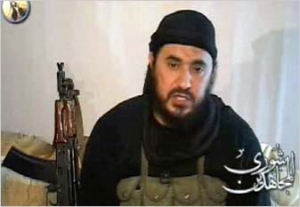
abu musab al zarqawiWhy didn’t we capture Zarqawi instead of killing him? (photo: Reuters)

ABC News got a big scoop on the other broadcast networks tonight by being the first by an hour or more to report that U.S. and Iraqi forces had located Abu Musab al-Zarqawi in a Baquba safehouse and killed him along with seven lieutenants who were meeting there. U.S. helicopter gunships may’ve provided the firepower which killed him. CNN is now reporting that Jordanian intelligence and possibly members of Zarqawi’s Iraqi network may’ve provided intelligence information beginning as early as two weeks ago allowing the Iraqis to pinpoint his location.

I find it hard to believe that NBC continued broadcasting Jay Leno and CBS continued with David Letterman while a competitor scooped them with news that the third most wanted man in the world had just been killed.

But what astonishes me even more is that the U.S. decided to blow him to smithereens instead of capturing him. After all, this is the second or third most wanted terrorist in the world. Wouldn’t capturing him alive have been an extraordinary coup? Either he provides you with extremely helpful information about his network and activities as some captives have done; or if he clams up you put him on trial before the world for his crimes as an example of what happens to people who do the things he’s done.

Not knowing the background for this operation, there may’ve been some reason that rockets were called in instead of forces to capture him. But on the face of it this looks like a typically rash and hasty decision by the Bush Administration at the expense of a future potential intelligence bonanza. In fact, it makes you wonder whether Bush and Cheney looked at the mess the Iraqis have made of the Saddam Hussein trial and said: “It’s just not worth it to capture and try him. Let’s just get it over with and embrace rough justice.”

UPDATE: Glad to report that this NY Times reporter is asking the same question as I. Here’s the answer U.S. forces provided to him:

As American commandos surrounded the house where they believed Mr. Zarqawi to be, the commander on the ground decided to call in the airstrike. It was not clear why the American officer decided against storming the house and capturing Mr. Zarqawi, which would have given the Americans a chance to interrogate him.

One reason, General Caldwell said, was that such an assault might have cost many American lives without any guarantee of taking Mr. Zarqawi alive. Another reason, asserted by Secretary of Defense Donald H. Rumsfeld on Thursday, was that Mr. Zarqawi might have escaped, as he had many times before when the Americans had him in their sights.

“You have to ask yourself: is it worth putting American men and women’s lives at risk to go in to what was probably a heavily fortified and guarded thing, in order to grab him?” General Caldwell said.

If I were in U.S. intelligence the answer to that question for me would be: “hell yes.” If you take this guy alive and you get him to talk think how many lives you save. Think how many Al Qaeda operations you thwart. Think how many Al Qaeda operatives you freak out by letting them think that Zarqawi is spillinghis guts to you. I’m for a little less blood lust and a little more consideration of the long-term benefits of bringing him in alive. But blood lust appears to have won out.

Another warning: no doubt the Bush Administration is going to be crowing tomorrow as they did after Hussein’s capture. But i say here exactly what I said then. Zarqawi was an important agent of terror in Iraq. Things can’t help but be a little better without his catalytic influence. But I see Zarqawi as a symptom of Iraq’s problems, not as a major cause. Zarqawi resonated in Iraq because its underlying problems presented him such fertile ground for terror operations. Nothing in the conditions on the ground in Iraq have changed with his death. His network will undoubtedly go on. I see very little changing there unless and until the U.S. decides to leave and/or the various Iraqi factions of Sunnis, Shiites and Kurds figure out a way they can live with each other. I don’t see either one of these developments happening anytime soon. Therefore, the chaos we’ve witnessed there over the past few years will continue and very little will change.

So if you hear talking heads tomorrow talking about a new day in Iraq, don’t you believe it.

Bush on Haditha Massacre: Marine Corps to ‘Reinforce That Proud Culture’

Thursday, June 1st, 2006

George Bush made another one of those tremendously awkward statements he tends to make when under pressure and when someone under his command makes a really, really big mistake:

Bush said he had discussed Haditha with Gen. Peter Pace, chairman of the Joint Chiefs of Staff. “He’s a proud Marine. And nobody is more concerned about these allegations than the Marine Corps. The Marine Corps is full of honorable people who understand the rules of war.”

“If in fact these allegations are true,” Bush said, “the Marine Corps will work hard to make sure that that culture — that proud culture — will be reinforced. And that those who violated the law, if they did, will be punished.”

Makes you wonder whether he wants to reinforce the proud culture of vengeance that enabled Marines to murder 25 Iraqis in cold blood. As for the “reassuring” statement that those who violate the law will be punished…Hmmm, where have we heard that one before? If anyone leaked Valerie Plame’s name they’ll be fired. Remember that one? Anyone who tortured at Abu Graibh would be punished. Remember that one? Would anyone like to put a little money down on the proposition that anyone will be punished for this incident? Of course, they’ll have to have a sacrificial lamb, a Lyndie England or Charles Graner. But what of the officers who approved the bogus story and allowed it to go up the chain of command?

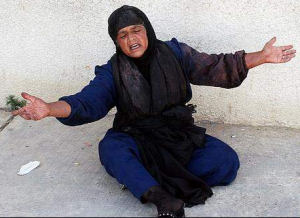
iraqi mourns death of relativeSuch wonders He/We hath wrought: mother-in-law, Rabia Mohammed Hussein grieves the death of pregnant Nabiya Nassayef (photo: Hameed Rasheed/AP)

I know that what I’ve written above is harsh…how can we be anything but harsh in light of these terrible events? But those Marines who tragically allowed their anger at losing a buddy swell into murderous vengeance are only a symptom of a greater evil. The entire enterprise of the war is evil. If we brought our troops home now such incidents would not happen.

Today’s news brings further horror with the murder of a pregnant Iraqi woman, Nabiya Nassayef and her cousin, Saleha Mohammed, traveling in a taxi to a maternity hospital where she was to give birth. The U.S. military’s initial statement claimed they were in an exclusion zone and refused to stop when commanded by U.S. troops to do so. According to the Daily Mail, a later statement withdrew the earlier one and said the women had been killed “by mistake.” “By mistake.” Don’t those two words encapsulate our entire enterprise in Iraq. Why are we killing pregnant Iraqi mothers about to give birth? What possible good are we doing for that country?